

BY Marco Gavita & Isabella Belafi
Aspiring author Dana Blue sets herself up in her room on Sunday nights. She lies on her bed, under a barrage of travel photos and memorabilia plastered to her wall, her laptop wide open, a tea by her side. It’s the weekend, and while other 24-year-olds take the evening to decompress after a long week in the rat race, Blue opts to work more, chasing her dream, filling page after page with the dialogue of lovers.
Blue is a published romance author. As with many others in this new age of authoring, her career took off on Wattpad, an online platform where aspiring authors share their stories with readers around the world, usually for free.
Since 2015, Blue, aka @Sinadana on the platform, has gained over 20,000 followers, racking up millions of views across multiple stories and springboarding her writing career into published work. Today, the author has more than 20 traditionally published books available for purchase through multiple publishers in multiple countries.
According to a study conducted by the Writers Union of Canada, Canadian authors are working harder while earning less than ever before. In 2018, Canadian writers made 27 per cent less from their writing than they did even three years prior.
Currently, the average writer’s income of $12,879 is a full $36,000 below the national average.
Despite her success, Blue works a full-time job in communications, even as her pen name appears in bookstores across Canada and France.
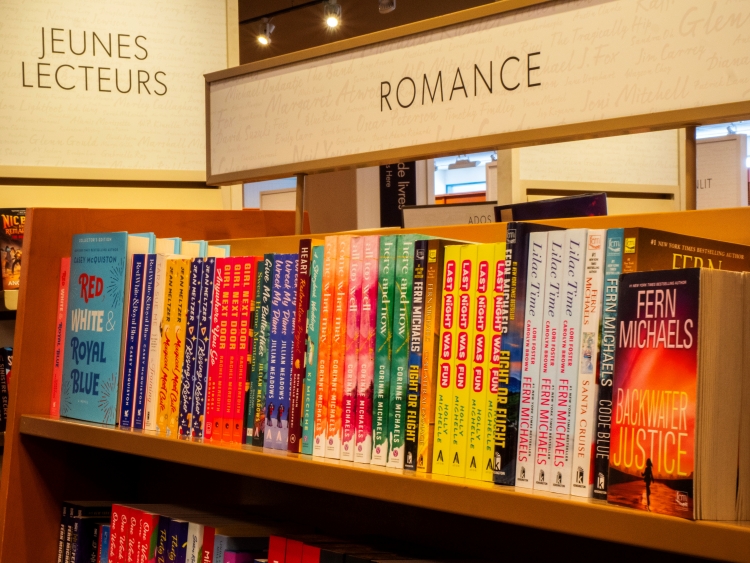
An array of romance novels for sale in Montreal. Photo by Marco Gavita.
The average published author in Quebec receives about 10 per cent of the profit from each book sold. If a book is sold for, say, $20, the author gets $2.
“You have to sell a lot,” Blue adds, discussing the financial side of writing.
Since publishing fees reduce authors’ profits to a fraction, most can’t get by on sales alone.
Though some can make a career from their art, the numbers are slim, and they’re even slimmer when considering French writers in Quebec.
“The thing is, in Quebec, a book is considered a bestseller if it sells 3,000 copies,” adds Blue. “So, if one book is a bestseller, you’re getting around $6,000. It’s a nice sum of money, but you have to sell a lot more.”
The finances behind writing
Independent authors keep their royalties. However, self-publishing also comes with often-overlooked costs, says Annie-Claude Larocque, president and founder of Les Éditions ÉdiLigne.
“We have a big team dedicated to helping our authors, compared to someone who is editing and publishing their own work,” says Larocque. “A publishing house is useful when it comes to editing, correcting, visuals, marketing, distribution and everything else that would cut costs from the author anyway.”
In Quebec, sanctioned events such as the Montreal and Quebec book fairs require authors to have published works in order to attend. In other words, authors must be affiliated with a publishing company to access events such as book fairs, cutting opportunities for independent authors.
Romance as a genre
According to a study by BookNet Canada, from 2017 to 2022, the overall sales of romance books increased by 42 per cent, while Romance and LGBTQ+ book sales increased by 10 per cent.
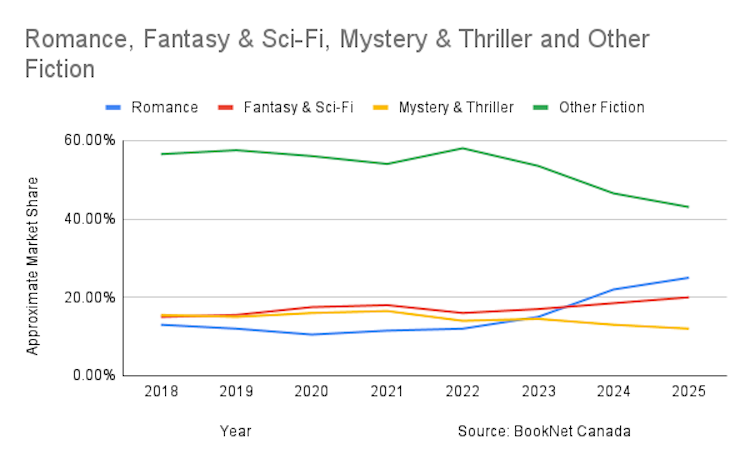
Since 2018, Romance has experienced the strongest percentage growth in Canada’s book market, expanding its share more significantly than any other major fiction category. What was once steady has become one of the industry’s most dynamic drivers. Photo by Marco Gavita.
Claire Trottier, co-owner of the Joie de Livres bookstore-café-bar, which specializes in romance and speculative fiction in Montreal, attributes this steep increase to multiple factors, though none more important than the sociological shift in the genre’s perception.
“A dismissive perception of romance has existed from the start and still exists today. I think at the base of it is misogyny,” Trottier says. “Romance is primarily but not exclusively written by women and for women, and you know, we live in a deeply misogynistic patriarchal society at the very core.”
Reasons for the steep rise in interest in the romance genre are debated, with the pandemic likely the main factor, as people had more time to read and discover new genres while at home.
“For me personally, it was the pandemic,” adds Trottier. “I think for many people, it was the pandemic. People were looking for comfort, were looking for joy”.
Even Jacob Tierney, writer and director of the hit Canadian television show Heated Rivalry, has admitted that he developed a passion for the romance genre during lockdown. He based the show’s screenplay on Rachel Reid’s Game Changer series.
Larocque echoes this sentiment. She notes the pandemic increased both the publishing house’s sales and the number of author submissions.
“Romance has always been a huge genre, but it’s almost as if people were shy to admit they read it,” she admits. “I mean, when we started publishing 10 years ago, we would cover the suggestive book covers with a jacket because people didn’t want to be seen reading romance novels.”
According to Laroque, readers have become much prouder of the genre since the pandemic began, embracing its nature and sharing their passion more freely on social media.
Despite the increase in sales and interest, many romance authors are struggling to turn their art and passion into a career.
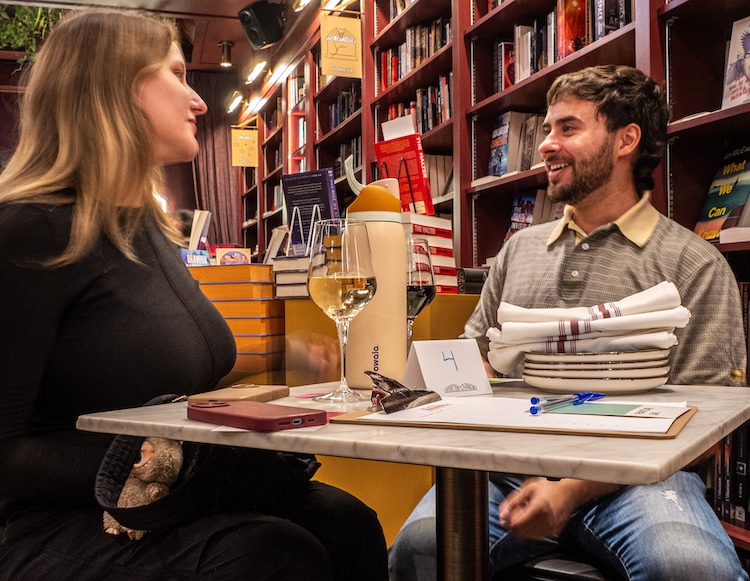
Two patrons toasting their drinks before the Heated Rivalry trivia night event at the Joie de Livres bookstore. Owner Claire Trottier prioritizes such events to promote community through an inclusive literary genre. Photo by Marco Gavita.
Strategies taken by authors
To counter the difficulties of publishing and the financial hurdles of writing, authors have adopted new ways to promote themselves and sell their work.
According to Statistics Canada, the book publishing industry has been bolstered by a resurgence in reading activity, with total sales rising 8.8 per cent to $1.4 billion in 2022.
Alexandra Roy is an author, editor, and journalist with over 20 years of professional writing experience. In her opinion, the writing industry has seen a clear shift since she started working, a shift that favours the modern author.
“Today, anyone can get in front of a screen and promote their work,” she says. “Anyone can get famous on TikTok and become a star, compared to 20 years ago, only the people who were invited to, like, Radio Canada would be promoted.”
Social media is a powerful tool for writers to promote themselves and their work, building a connection with their potential audience at little to no cost.
Despite this, Roy recognizes that the art form has changed, focusing more on personality than on the literature itself.
We’re not selling books anymore, we’re selling people.”
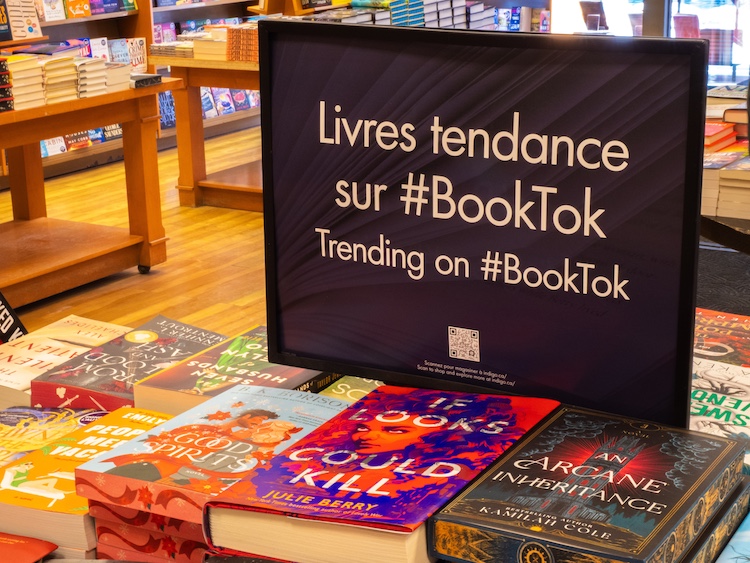
Romance novels displayed on the shelves labelled Trending on BookTok at the top of the Indigo bookstore escalator on McGill College Ave. The BookTok movement on social media is one of the main drivers of the romance boom across literature, a first in the industry where people have influenced a genre’s popularity through online communities and interactions. Photo by Marco Gavita.
The author’s plight
The industry got a boost when the television adaptation of the romance novel “Heated Rivalry” achieved massive and sustained success. In 2025, it became the top-rated acquired, non-animated series on the HBO Max platform since 2020.
Once a niche genre tucked away on bookstore shelves, queer romance is now front and centre. Fans are gathering online, in bookstores, and at watch parties to celebrate stories like Heated Rivalry. The global hit reflects a broader shift in how queer love stories are being told and represented. Video by Isabella Belafi.
“It’s motivating,” said Blue. “Shows like this are getting more and more traction, and it opens doors for authors like us who follow. I can only hope that one of my novels gets the Heated Rivalry treatment one day.” Looking back on her career, Blue reflects on how far she’s come while acknowledging how much more she can grow as an artist as the genre evolves.
“Dreams evolve over time, you know?” says Blue. She has had the opportunity to check many dreams off her list.
“At the beginning, my dream was to get a book published. There you go, check,” she says. “Then it was to go to France, check. Then, to be featured in a library, check. Then it was to receive fan art of my books, and I did”.
The author emphasizes that her dreams evolve over time, but her next goals are to reach 10,000 sales of a book and to have one of her works translated into English.
Despite the genre’s growing popularity, opportunities remain limited for writers. Blue welcomes new voices in romance but still feels the pressure of intense competition in an unforgiving industry.
“Competition and rejection are parts of the writing process,” Blue emphasizes. “If I’d been counting, I’d be up to around 200-300 rejections [from publishers] at this point.
Larocque admits that the significant increase in submitted works from new authors is impossible to keep up with.
According to Larocque, at capacity, Les éditions ÉdiLigne can publish between 30 and 40 stories a year.
”We receive around 80 stories per month, easily. If we see that out of the 40, we already have 20 spots guaranteed to our internal writers, then the space we have to publish new authors is even more limited.”