BY Yasmine Chouman & Kayla Ifergan
Growing up in the 70s, Nathalie Conroy was taught that clothes were an investment. She lived that way until she had kids in the early 2000s, when money became tight. Now, with social media, she scrolls through Instagram or Facebook, and the ads for cheap clothes catch her every time.
“I love to stay with the trends,” she says.
Conroy says she shops at fast-fashion stores because they offer trendy pieces at lower prices.

Nathalie Conroy shops for trendy new pieces at Winners in Dollard-Des Ormeaux, on February 12, 2026. Conroy loves shopping, even if it’s just for fun. Photo by Yasmine Chouman.
Sitting on her couch wearing an H&M outfit, she says, “I love getting sales, I get so excited.”
She says her sweatpants were $10 and her top was $5 on sale.
“If it rips after a few wears, who cares?” she says. “It was five dollars!”

A look at the global market value of fast fashion from 2021-2027. Graph by Yasmine Chouman.
Conroy is not the only one to feel this way. According to Fashion Dive and The Business Research Company, the market value for fast fashion is projected to be $192 billion by 2030. In contrast, the slow fashion market value is increasing at a much slower rate. In 2025, the market value was $12.46 billion and varying experts suggest that it will grow to $33.05 billion by 2030.
This phenomenon can be linked to everchanging trends on social media where they start from “regular” people and move upward to the fashion elite. This was made possible because of fast fashion.
Shein, the largest online fast fashion brand, is known to add between 2,000 to 10,000 new items to their website every day, contributing to oversaturation of the fashion market.
Fashion trends are constantly changing and people are trying to keep up. Video by Kayla Ifergan.
Milan Tanedjikov is a fashion design teacher at LaSalle College and the founder of Lignes de Fuite – an independent fashion incubator for post-grad design students.
“Not everyone can afford luxury brands or local designers’ pieces,” he says. “Which is what makes this a viable sector that most likely won’t be going anywhere any time soon.”

Milan Tanedjikov mentors post-grad students at his studio on St-Ambroise Street, on February 15, 2026. Every Sunday, a small group of designers get together as a part of Tanedjikov’s Lignes de Fuite program. Photo by Yasmine Chouman.
He finds social media trends boring, especially because algorithms tend to push what’s popular.
“I like going to real events,” he says. “People come in there and they’re truly cool – not Instagram cool, you know?”
Tanedjikov says that it’s overwhelming with all the new things happening in fashion – there’s a saturation of novelty, imagery, and styles online.
“Fashion is very reactionary,” he says. “So when something becomes too much, it’s a prompt to do something different.”
Tanedjikov explains that today’s young designers create new ‘drops’ month after month to keep up with people’s interests and the rapid pace of social media.
“It’s a vicious cycle,” he says.
Rayhanne Coralie Alexandre, a slow-fashion lover and founder of her mini-magazine, ‘Sunshine of Ray’, uses fashion as a statement.
“I take what I wear really seriously,” she says in a phone interview. “I use fashion in my day-to-day life to break the norm.”

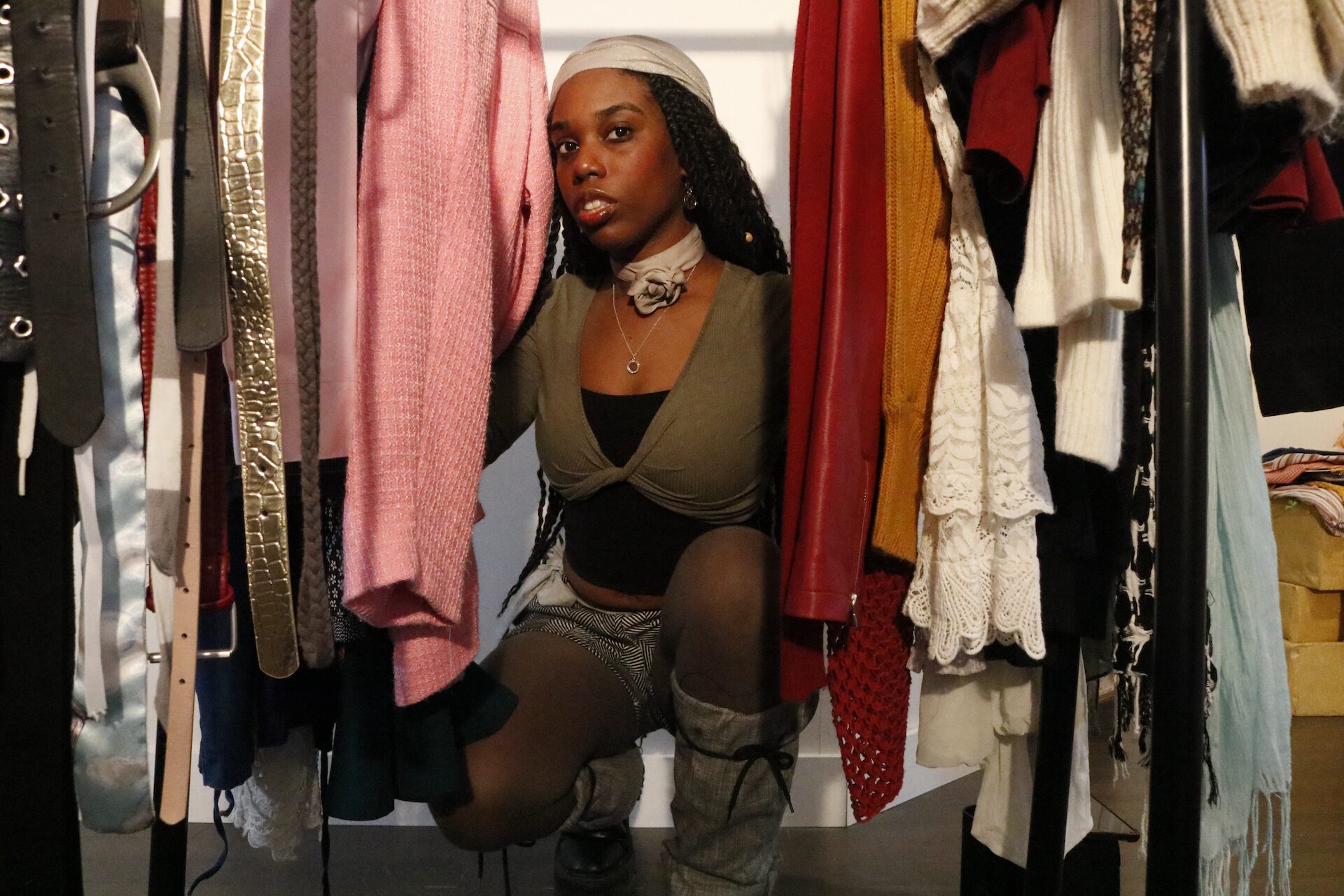
Rayhanna Coralie Alexandre styles her outfits at her home in Blainville. The 23-year old carefully curates her style every day. Photo by Yasmine Chouman.
Although this wasn’t always the case. If you met her three years ago, you would’ve caught her wearing jeans and a black hoodie from Zara. But since her last year of university in 2024, she has committed to finding her personal style.
“Every day was the same dreary black, white, grey or nude colour,” she says.
To challenge the conformity of fashion she’d been seeing everywhere, she first started by styling an outfit by pairing two “unlikely” colours of clothes she already had in her closet. Then she experimented with textures, shapes and patterns.
Tanedjikov likes to see people breaking the boundaries of what society deems acceptable. To him, creativity means straying away from the limits set upon us and going toward our true selves.
According to him, trends are a group-imitation phenomenon.
“It’s these repetitive saturations of sameness,” he says.
The fashion scholar credits the postmodern era of hyperindividualism with fashion conformity. He explains that the ability to express yourself through fashion has become less about fitting into a collective identity – like punk, goth, or skater – and more about “being different.”
He recommends building a collection based on personal experiences and primary sources—such as art, music, architecture and books—rather than relying on secondary sources like social media.
“Fashion is our one avenue of politics that you control as an individual, as of right now,” Alexandre says. “So you should make the changes you want to see, starting from your own personhood – be open and be you.”
She gets all her clothes from hand-me-downs, thrifting, or by reusing some of her older pieces and styling them in new ways. Rather than contributing to fast fashion, she upcycles her clothes at home.

Rayhanne Coralie Alexandre chooses what pieces work best together in her home in Montreal, on February 12, 2026. Alexandre is passionate about up-cycling your own clothes to create a fun personal style. Photo by Yasmine Chouman.
She is one of the many Gen Z youth who are willing to spend 10 per cent more on sustainable products. They have been deemed the “sustainable generation.”
For Alexandre, before making an impulsive decision to buy inexpensive and mass-produced clothing items she sees online, she pauses to ask herself a few questions.
“Do I really need this bubble skirt? What would I have at home that I can style with this? Can I wear this item in different ways? Can I re-create this item with a piece I already have at home?” she asks. “In the long run, you’re wasting less money, buying better clothing, and finding creative ways to style yourself.”
Designer Andrea Recinos-Carballo uses this non-conformity ideology in her designs. She takes her inspiration from movies, music, her culture, and the 70s rock-and-roll era of fashion. But she admits it’s difficult to always avoid trends.

Andrea Recinos-Carballo sketches her designs at UQAM, in downtown Montreal, on February 11, 2026. Recinos-Carballo draws what comes to her, then watercolours her sketch before bringing it to life. Photo by Yasmine Chouman.
“Even if you try to stray away from the trends, you won’t necessarily be able to because trying to stay away from the trends is a trend,” Recinos-Carballo says.
She says designers have to catch up with trends that aren’t even being set by their peers in the fashion industry, as they used to be. “It’s no longer the designers, models, or creative directors setting the trends; it’s literally everyone,” she says.
“You don’t have to be a creative person to create a trend anymore,” she says.
“I feel like it was easier to be a designer before social media,” she says. Trends used to last seasons, which gave the designers time to curate a new collection that kept people excited for months.
“I don’t think of it politically or anything like that,” says Conroy. “I just think that it’s fast, it’s fun, it’s cute and I feel good in it. If you feel good in it, that’s what’s important.”