
BY Isabella Belafi & Claudia Beaudoin
A group of young people step into North Star Pinball on Saint-Laurent Blvd. They gather around a pinball machine, unsure where to begin. They search for a screen, a prompt, something familiar. There isn’t one.
They ask someone how to use the machine. They place a coin in its front slot, and a quick clink lights it up. The game begins.
Bartender Sabrina Cartier laughs at the group of young newcomers as she remembers her first time playing pinball at North Star.
“It was a date, but we didn’t talk. I just got locked into the game,” Cartier says.
What started as a casual date night quickly turned into something more.
She kept frequenting the bar, not just for the game, but for the people who surrounded it.
“I wasn’t good, but the community was so inviting to teach me that I felt comfortable learning,” she says.
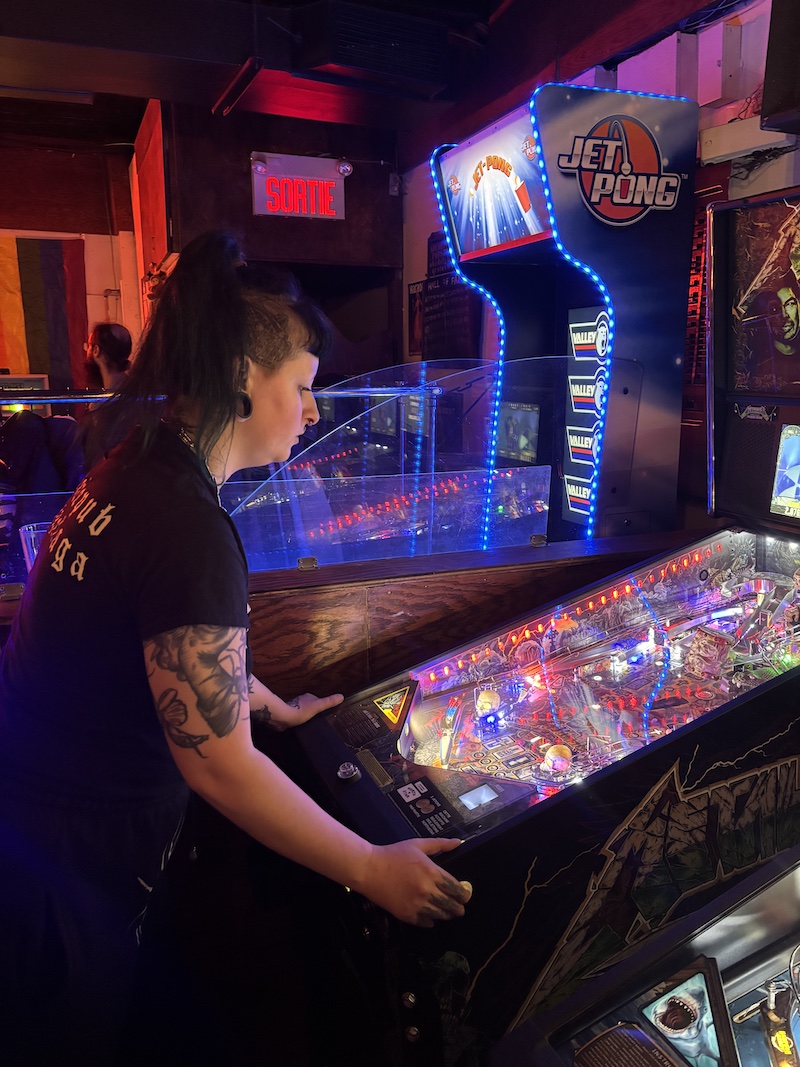
After her shift, Sabrina Cartier plays a game at North Star Pinball, moving from behind the bar to the machine. Photo by Isabella Belafi.
Over time, Cartier’s connection to the space led her to start working behind the bar.
“Even though I had no bartending experience, they loved my vibe and hired me anyway,” she says.
Now, she gets to help newcomers feel the same way she once did.
“People come for something else and then fall in love with pinball,” Cartier says.
A new generation is discovering pinball for the first time. And it’s not just in Montreal. Players aged 18 to 29 now make up the largest share of competitive pinball participants worldwide, at 32 per cent, according to the International Flipper Pinball Association.

Competitive pinball tournaments show a growing number of younger participants, reflecting a renewed interest in the game. Infographic by Isabella Belafi.
“It’s really cool to see them turn on to it,” says Robert Baraké, a Montreal pinball repairman who has been working with machines since the 1980s.“I played my first pinball machine in 1977.”
At the time, he was just 12 years old. The machines had only recently been reintroduced in Montreal after a long-standing ban tied to concerns over gambling and crime. For Baraké, that moment sparked a fascination that would shape the course of his life.
He bought his first machine when he was 17, teaching himself the mechanics. What began as curiosity quickly became something more serious.
“I learned to fix them from there. I took it apart and put it back together,” Baraké says.
As digital entertainment took over in the late 1990s, machines were pushed out of public spaces almost entirely yet again.
“They died off in 1999. You couldn’t find pinball machines in public locations,” he says.
Now, he is watching that cycle reverse as a new generation encounters the game for the first time, often needing to be taught how to play.
“We had a lot of 20-year-olds come in. They didn’t know where to put the coin in,” Baraké says.
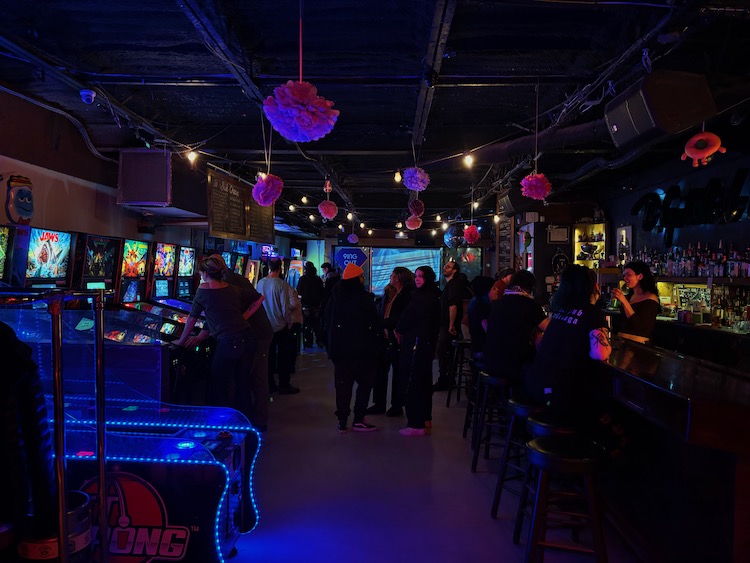
A packed crowd fills North Star Pinball, highlighting the bar’s role as a destination in Montreal’s evolving nightlife. Photo by Isabella Belafi.
Bruno Durivage, co-owner of North Star Pinball on St-Laurent Boulevard, came into the space not as a pinball expert, but as someone drawn to its atmosphere.
“I used to come here with friends and play,” he says.
After developing a relationship with the original owners, he eventually took over the bar side of the business, combining his background in hospitality with their technical knowledge of the machines.
When North Star first opened in 2015, pinball machines were still heavily restricted in bars. “It was not allowed to have more than three machines and sell alcohol in the same location,” Durivage says.
To operate, the bar had to function under a pilot project while the provincial government reconsidered outdated regulations tied to pinball’s association with gambling.
Despite those limitations, the space quickly built a following. At the time, pinball was still considered a niche interest.
In April 2017, Montreal officially lifted those restrictions, allowing pinball machines in bars after decades of prohibition. Since then, more than one-third (31 per cent) of Montreal’s pinball machines are now located in bars, according to the Montreal Pinball Map.
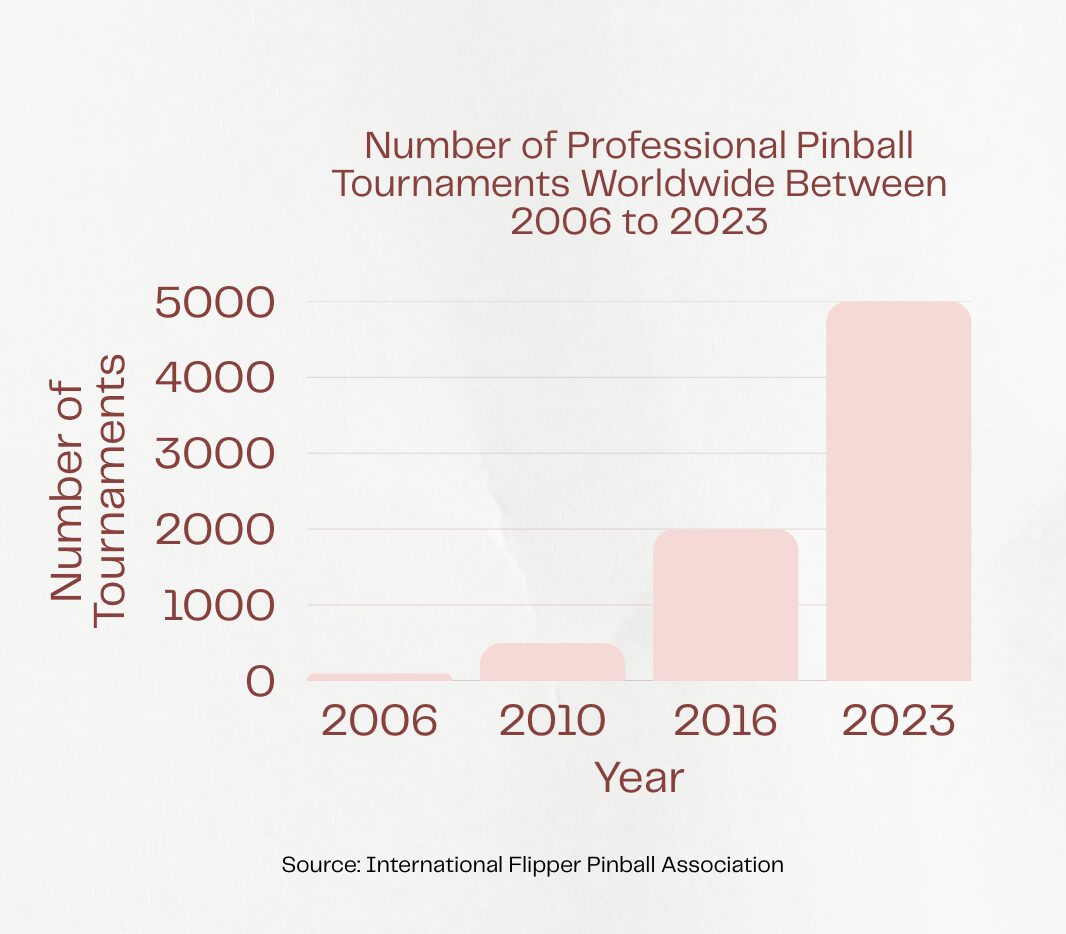
Pinball competitions have grown rapidly over the past two decades, showing the game’s resurgence globally. Infographic by Isabella Belafi.
“When North Star opened, it was kind of underground,” Durivage says. “Now, it’s more mainstream.”
Durivage has watched the audience expand beyond longtime enthusiasts. “New people join the hobby every week,” he says.
Baraké agrees. He’s noticed that newer machines are increasingly tied less to the quality of the pinball machines and more to how they’re marketed.
“The operators and the guys who would buy pinball machines to put them in bars would never buy a pinball machine without trying it first,” he says, explaining that the mechanics of the machine were most important to buyers.
In today’s era, that process has changed. “With their marketing strategy, people buy them online before it’s produced, because of the theme,” Baraké says. “There’s companies like Stern Pinball that are coming out with games, like Pokémon.”
He’s noticed a shift in how machines are designed to attract players by appealing to familiarity. “You can’t put out a pinball anymore without a commercial license because people need to be attracted to it,” he says.

A Dolly Parton-themed pinball machine at North Star Pinball reflects the industry’s shift toward licensed branding to attract players. Photo by Isabella Belafi.
Over the years, Baraké worked across different parts of the industry, from servicing machines to working with distributors. Now, as he approaches retirement, his work has shifted again, this time into repairing machines in private homes.
“There’s just so many machines in people’s basements. It’s crazy,” he says.
While long-time players remain part of the core community, Durivage has noticed how the bar now attracts a wide range of visitors. “We get people that are like 19 to 70 [years old] coming in,” he says.
At North Star, the machines are more than entertainment; they are part of a community where people bond over a shared interest.
“In nightclubs, maybe people are joined by their love for music. Here, people are joined for their love for pinball,” Durivage says.
He describes the bar as a “third space,” a place separate from both home and work where people can gather. But rather than simply drinking or socializing passively, customers can engage in an activity.
“Here, everybody’s welcome […] you have an activity to share,” he says.
For Durivage, keeping the space accessible is intentional. He says by keeping prices reasonable compared to most spots in the city, the bar attracts a diverse crowd across age groups and backgrounds. “We created a very heterogeneous community through that,” Durivage says.
Will Straw, a McGill professor of urban and cultural studies, is observing a shift in how younger generations choose to spend their time. “Clubbing is really declining,” he says. “There’s also a decline in the extent to which younger people drink alcohol now.”
Instead, he says, many people are turning toward environments centred on social activities rather than partying. “They would much rather socialize with their friends,” he says.
Billiards is seeing a resurgence in Montreal, with more young players reshaping the scene. For many, it’s less about competition and more about connection. Video by Claudia Beaudoin.
This change is also connected to the cost and accessibility of Montreal nightlife as it’s become increasingly expensive and less appealing. “People want quieter, cheaper forms of entertainment,” Straw says.
This shift goes beyond nightlife, Straw added. Gen Z grew up with rapidly evolving technology. They are now drawn to and nostalgic for older, more interactive activities.
“A lot of younger people are buying portable cameras, even though they can use their phones, or buying cassettes and vinyl records,” he says.
It signals a return to things that can be held, played and shared.
“They’re not rejecting technology entirely,” Straw says. “They’re going back to earlier forms that seem simpler and more material.”