
BY Desirée Zagbai & Alexander Burke
When Montreal unveiled the city’s 2026 budget, there was an extra $30 million to support initiatives and community organizations that work with people who are unhoused.
Éric Latimer, chair of the non-profit shelter Open Door in Montreal, says the city should focus more on helping unhoused people secure housing.
“Let’s reduce the number of people who are experiencing homelessness, and that involves providing housing for them, which we can do through rent subsidies,” Latimer says.
He supports the city’s plan not to dismantle encampments without offering alternative housing and improving living conditions at the sites. However, he highlights that the plan does not include individualized exit strategies.
He says each person should be assessed individually and provided with a housing plan.
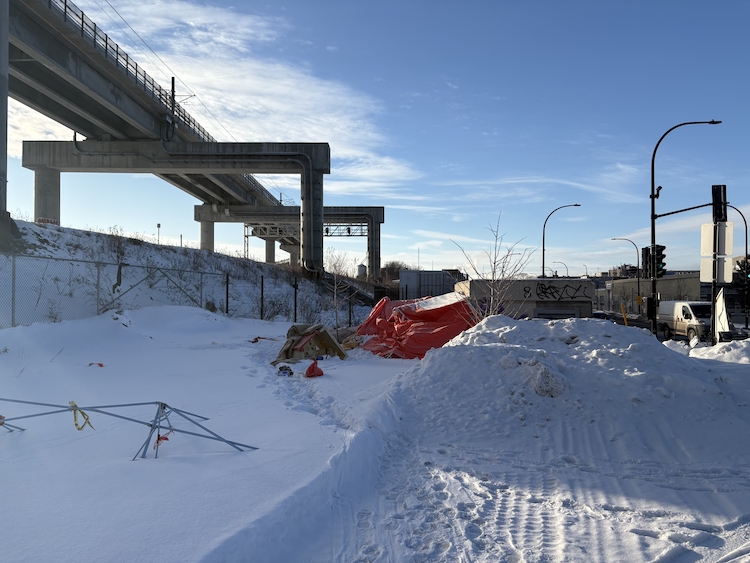
An encampment in Pointe-Sainte-Charles, Montreal. Photo by Desirée Zagbai.
Latimer adds that the current administration can express its willingness to reduce the number of unhoused people in the city and push the provincial government in that direction.
“My observation of the local government is that it has really not cared that much about this issue, not to the extent that is warranted,” Latimer explains.
According to him, some of the main reasons people become unhoused range from gambling, addiction, and mental illness. Often, individuals who have been in the youth protection system, without a positive start, later become unhoused.
Latimer hopes being unhoused in Montreal will become rare.
“And when they do, they would quickly receive the help they need to regain stable housing,” he says. “As a result, on any given day, very few people would be homeless.”
Sam Watts, CEO and executive director of the Welcome Hall Mission, says that the mayor’s $30 million investment will be helpful in the frontline operations.
“We always need to applaud politicians who keep a promise. In her campaign, she said she was going to triple the budget for homelessness; she did,” Watts says. “Frontline services are wonderful, but you need to be working on getting them back into housing, and of course, the best thing you can possibly do is prevent people from falling into homelessness in the first place.”
Montreal has opened new heated overnight shelters this winter to protect people from extreme cold. As capacity expands, experts say emerging measures must be paired with long-term housing solutions. Video by Alexander Burke.
Watts explains that preventing people from becoming unhoused isn’t necessarily the city’s responsibility, but that the city is making a good effort with its investment as it invites other parties to the table.
“The city is sending out an important signal here, and that signal is ‘we’re taking responsibility for the city of Montreal for the territory in which we operate,’” Watts says.
Watts says that at Welcome Hall Mission, they house approximately one person per day.
According to the Québec Ministry of Health and Social Services, between 2018 and 2024, the number of unhoused people in Montreal increased significantly.
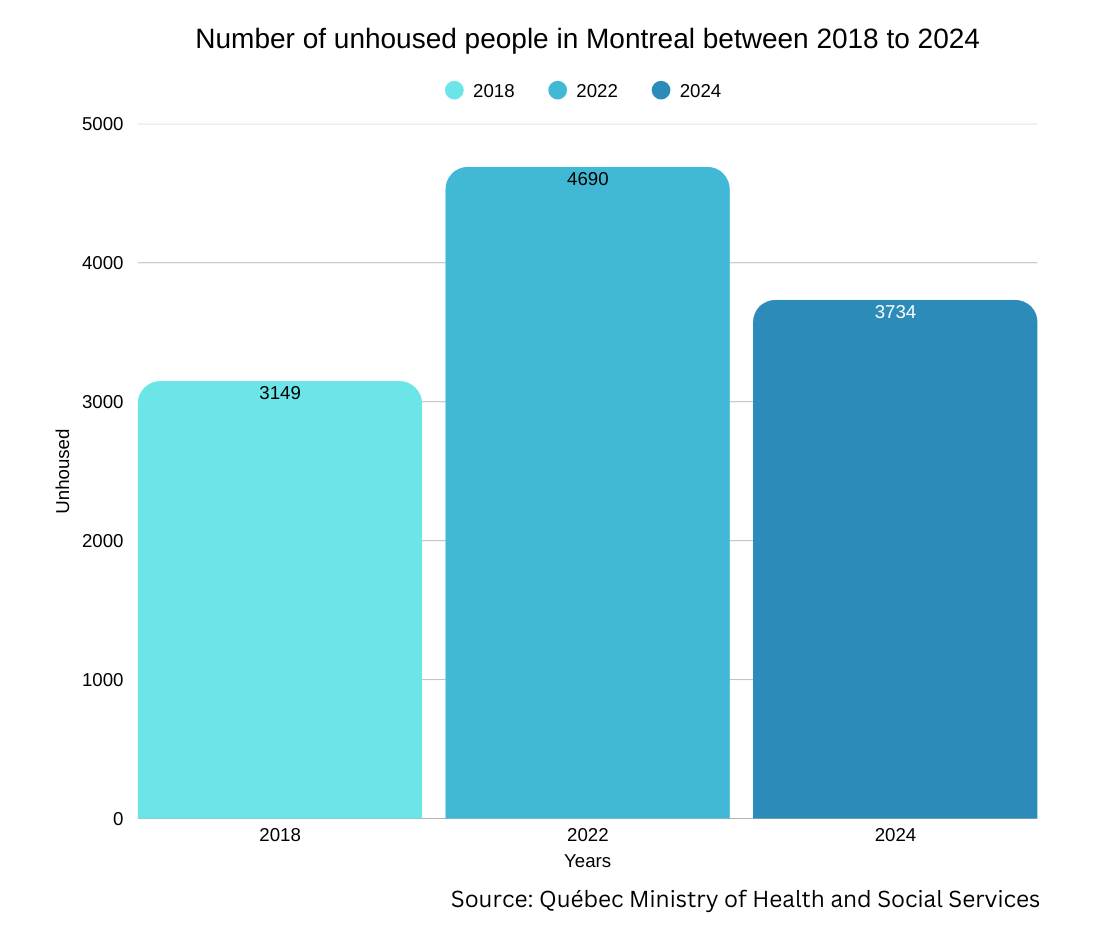
The number of unhoused people in Montreal from 2018 to 2024. Infographic by Desirée Zagbai.
Political analyst Daniel Tran believes that the city’s $30 million investment is good news.
He adds that one of the main challenges community organizations that work with the unhoused may face is that most of the budgets they receive are not recurrent and that makes it hard to hold on to employees.
“If you’re all constantly having a turnover in your own non-profit organization, it’s hard for you to really help the community because even you don’t have predictability,” Tran says.
Martinez Ferrada ensures that the new unhoused budget will last for three years. This will help non-profit organizations determine what they can pay their employees during this period.
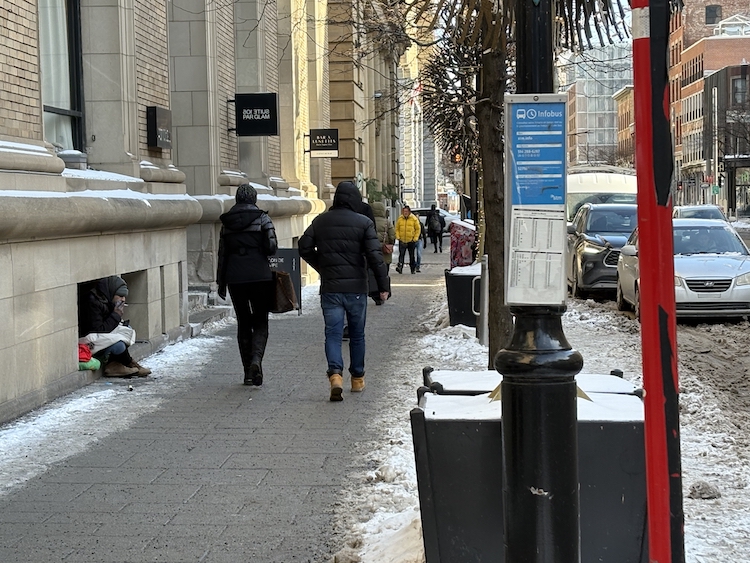
Ville-Marie is one of the areas in Montreal where unhoused people are more prevalent. Photo by Desirée Zagbai.
“People will be more encouraged to stay and make a difference,” Tran adds.
Tran says that because of the current housing crisis in Montreal, the city’s affordability must be addressed. According to a Statistics Canada report, asking rents in Montreal have increased by approximately 71 per cent since 2019, while it’s roughly doubled in some other Quebec cities.
“There’s a task force administratively, but there’s also a political task force,” Tran says. “So our expectations are high. We hope that she delivers.”