

BY Geneviève Sylvestre & Mélanie Tremblay Turgeon
Katherine Pichette is a veterinary technician and long-time cat foster. For her, caring for animals comes as naturally as breathing.
“I’ve been drawn towards working with animals since I was literally a baby,” she says.
Often acting as volunteers, animal fosters temporarily house shelter animals while they await adoption, offering them a more stable environment than a shelter can and freeing up space in facilities.
Due to rising costs of living, owning and fostering animals is becoming increasingly inaccessible with many families struggling to cover the costs of pet food, toys and litter.
Vet care can also be a considerable expense for animal owners struggling to get by.
“I think what people struggle with most right now in this age is really affording their vet bills,” Pichette says. “A lot of animals suffer with illnesses that owners don’t have the funds to treat, so they’ll opt into getting their animal euthanized instead of being able to afford the medical bills to heal their animals.”
Despite passionate people like Pichette opening their homes to pets in need, the level of commitment and money needed to take care of animals is very high. So many end up on the streets or in an animal shelter when their owner can no longer care for them properly.

Hashbrown the dog out for its walk in the yard at Proanima facilities in Boucherville. Photo by Geneviève Sylvestre.
Prior to this year, each borough was responsible for caring for its abandoned animals, with most using the SPCA. However, at the start of 2026, the city decided to centralize animal care and signed a decade-long, $157.9-million contract with the nonprofit Proanima.
Proanima has been operating in the South Shore of Montreal since 2012 and recently opened its first Montreal facility on Pie-IX Blvd., with another one set to open in the west of the city later in 2026.
According to data from the Montreal SPCA, animal abandonment is on the rise, with 2025 seeing a 26 per cent increase in animal surrenders compared to the year prior. This marks the fifth year in a row that animal abandonment has increased in Montreal.

The number of animals taken in by the Montreal SPCA from 2018 to 2024, according to data for the organization’s annual reports. Infographic by Geneviève Sylvestre.
Program director for Humane World for Animals Canada, Ewa Demianowicz, says it’s a “great sign” that the municipality is funding a centralized animal care service.
“Most progressive urban cities in North America run their animal services facilities and, that way,” she says. “We really ensure that the best standards are being respected, that profit is not the driver for operating a facility like that.”
According to Proanima’s executive director, Anny Kirouac, one of the major benefits of Proanima’s larger network is that it increases resilience, ensuring that needs can always be met.
“When you have a larger team and different locations, if anything happens to your installations or your staff, you still have people working to ensure that citizens and animals can still receive the services that they need,” says Kirouac.
Calling itself a “one-stop hub,” Proanima is now responsible for accepting surrendered animals across Montreal and offers an adoption service for cats, dogs, and some exotic animals.
For Proanima, education is an important way to mitigate animal abandonment.
Kirouac says that many people choose to surrender their dogs due to behavioural issues, like excessive barking or resource protection. As part of its education program, Proanima can offer tips and training resources to owners in these situations to try to help them keep their animals.
“Does it work every time, no, but I would say one time out of two it does, which is really great,” she says.
Another increasingly common reason owners abandon their pets is financial, mainly due to the costs of caring for a sick animal.
To try to combat this, Proanima offers reduced-cost sterilization and microchipping services for low-income residents and hosts pet food donations and a pay-what-you-can thrift store for people to obtain affordable pet supplies.
Proanima also offers temporary accommodations to animals in need, allowing pet owners in vulnerable situations the opportunity to surrender their animals for a short period of time instead of giving them up completely.
Despite the city centralizing animal care, a number of smaller, unaffiliated, non-profit shelters and rescues exist in the Greater Montreal area.
Montreal is host to a large network of animal shelters working independently of the city and borough. Video by Mélanie Tremblay Turgeon.
Olivia Doulos is the founder of Passion for Paws, a non-profit, foster-based animal rescue focused on rehoming dogs in need.
According to Doulos, it can be very difficult to find dog-friendly housing in Montreal, which she says is another common reason why people are forced to abandon their animal, even if they don’t want to.
“I think the city could definitely accommodate the general public better,” she says. “I feel like the housing community and the restrictions when it comes to having a dog makes it really hard to keep them as your life changes and your circumstances change.”
Even in apartments that allow pets, Doulos says many have restrictions against dogs over a certain weight due to concerns about noise complaints or that their nails could damage the flooring. She believes solutions as simple as providing proof of regular nail trims to a landlord could help more people keep their pets.
Doulos also believes the city should be doing more, especially when it comes to cracking down on backyard breeders not affiliated with the Canadian Kennel Club.
“You can decide one day that you wanna go get a dog and you can look up that dog on Kijiji and go buy one that same day,” she says. “A lot of those Kijiji dogs end up in the system a few years later.”
Despite foster environments being less stressful for most dogs, city shelters remain important in ensuring all animals have a chance to receive care.
“At the end of the day, you do need a facility that can say yes to everything,” says Doulos. “The issue that a lot of smaller rescues or shelters find themselves in […] is that we don’t have the resources to accept every single dog that comes knocking on our door.”
However, for Doulos, there are still concerns about overcrowding and the quality of life for pets in large shelters, as they are kept in cages for most of the day in close proximity to other animals.
“I think trying to support shelters working with smaller rescues to help with the workload and to get as many dogs into foster care as possible is really important,” says Doulos.
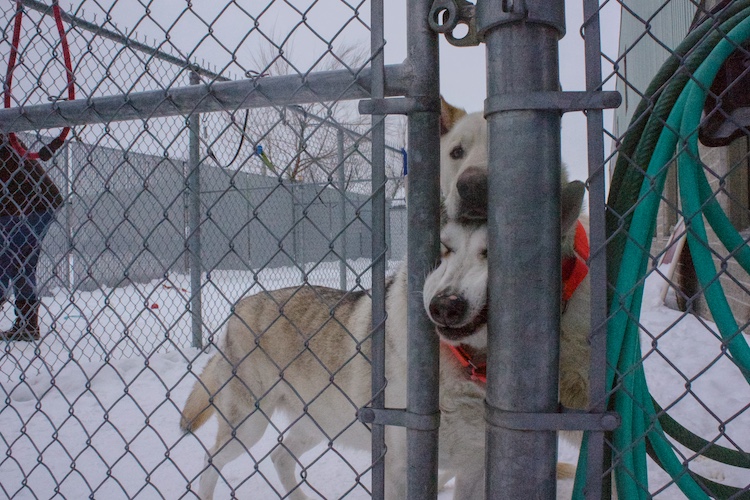
Two huskies playing in the yard at Proanima facilities in Boucherville. Photo by Geneviève Sylvestre.
Among its other responsibilities, Proanima also runs a community cat management program to control the stray cat population.
Demianowicz says that while she can’t comment specifically on Proanima’s practices, Trap-Neuter-Return (TNR) is a well-respected way of controlling cat populations in urban areas.
“Many urban cities face this problem in North America, and TNR is usually the most humane approach to deal with feral cats that live outside,” says Demianowicz.
Proanima claims that the organization has noticed a decrease in the population of stray cats in the areas it serves on the South Shore since the start of the program, namely a decrease in the number of orphan kittens––leaving room to temporarily house pets in need.
Beyond operating a shelter, Demianowicz says it’s important for cities to have a system to enforce regulations governing the treatment of companion animals, like a complaint system for citizens to report abuse.
“Unfortunately, even if we have good regulations, there will always be people in violation of them so the neglect of animals will still happen,” says Demianowicz.
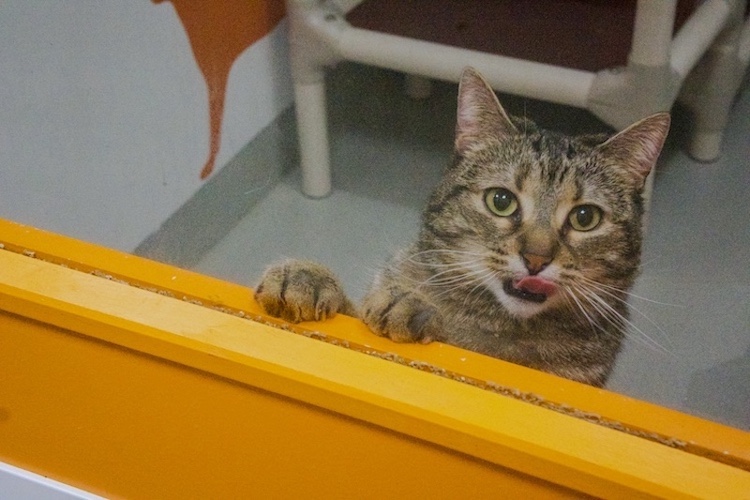
Mymy, a cat surrendered to Proanima facilities in Boucherville, licking its lips. Photo by Geneviève Sylvestre.
Ultimately, Demianowicz think it’s important for animal management to not only be a municipal concern, but also to ensure the best treatment of companion animals in Montreal and across the province
“It’s important that governments work together so as to make sure that they’re aligned, that they work towards the same goal, which is treating animals as members of our society, as sentient beings.”


