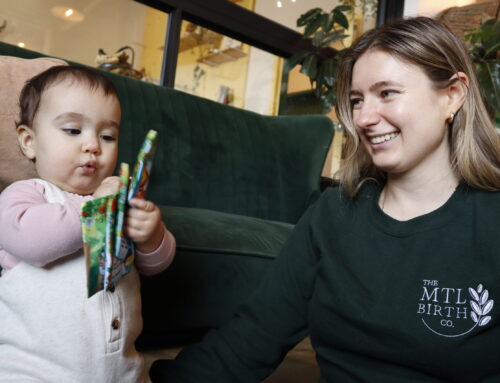

BY Demetra Kritsidimas & Kassidy Jacobs
In a studio tucked into Montreal’s Old Port, Pilates instructor Charlotte Appel is running through Pilates sequences she first learned thousands of kilometres away in Bali.
She writes her classes at home, then rehearses any new moves before her classes start, adjusting the weight to make sure it feels right.
“Doing it makes you feel better about teaching it,” she says.

Pilates instructor Charlotte Appel goes over some Pilates movements before four hours of classes. Photo by Demetra Kritsidimas.
Alongside her 100 hours of online training, Appel spent three weeks on the Indonesian island earning her Pilates instructor certification.
“It was morning sessions on the mat, and afternoon sessions on the reformer every day,” she recalls. “We just went over all the movements and all the ways to cue movements and teach them to other people.”
Now back in Montreal, Appel, who once worked full-time in marketing, teaches at Maison Pause, a wellness studio which opened last November.
It’s part of a shift in how fitness is approached; one that is less about access and more about experience.
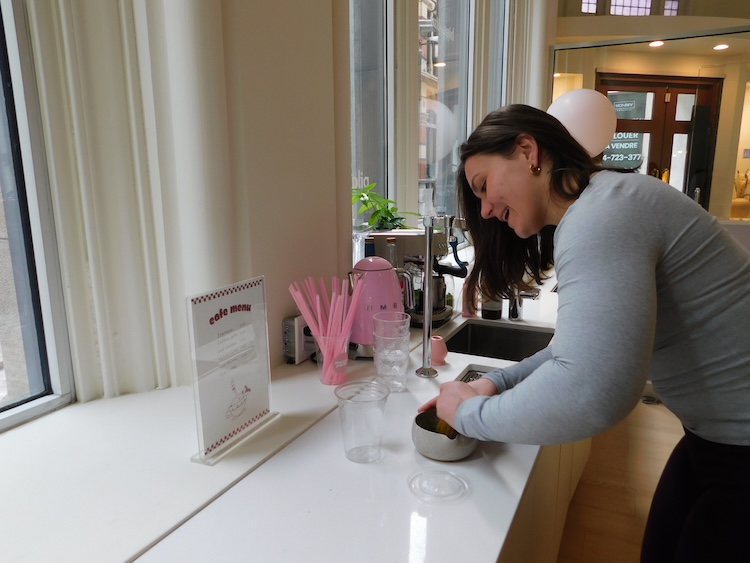
Appel makes herself a matcha as she recalls how she got her Pilates certification. Photo by Demetra Kritsidimas.
“‘Boutique fitness’ is not a single category,” says Erin Phelan, Communications Director at the Fitness Industry Council of Canada. “It refers to specialized, experience-driven studios built around a specific modality and a strong sense of community.”
That includes Pilates, yoga, cycling, strength training and high-intensity interval training, but they are not all growing in the same way, according to Phelan.
“Over the past several years, boutique fitness has grown, but not uniformly,” she says.
Some formats are accelerating, particularly Pilates, strength-based training and recovery-focused classes, while others, like indoor cycling, have plateaued.
Data supporting this shows that yoga and Pilates studios alone account for 22 per cent of all fitness studios in Canada, making them the most popular specialized category.
Phelan highlights that attendance at many studios has bounced back to, and in some cases, surpassed pre-pandemic levels.
“This reflects a broader change in how people define fitness,” she says, pointing to a move away from calorie-burning workouts and towards strength, longevity, and identity.
For Appel, the appeal is simple.
“Sometimes you just don’t want to do movement on your own,” she says. “It’s annoying, you get bored.”
That structure is a major draw, according to Mark Eys, a professor and Laurier Research Chair in Group Dynamics and Physical Activity at Wilfrid Laurier University.
“People get into a routine,” he says. “They get to know the instructors, they get to know the other people, they have their particular place, their territory in the class where they’re putting their mat, which bike they’re jumping on.”
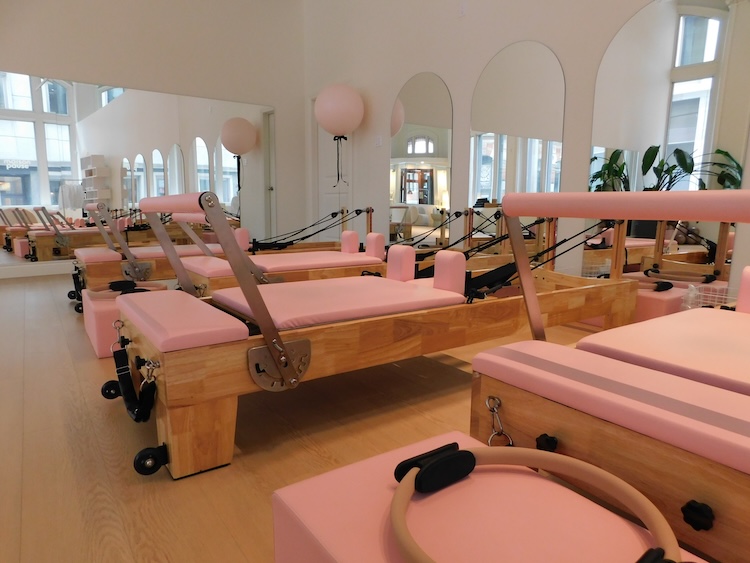
Pilates reformers inside the Maison Pause studio in Old Montreal. Photo by Demetra Kritsidimas.
At the Vaudreuil Idolem Hot Yoga studio, owner Steph Woo says the impact of group settings is clear.
“People feel the accountability when there are people around,” she says. “The energy is super important. When your class is full, and there are 40 others doing it with you, you get that energy with them, you’re not by yourself.”
That energy often turns into something more social. Regulars attend the same classes weekly, building relationships that go beyond the workout itself.
According to Woo, that added experience is part of what people are paying for.
“It’s not just yoga. If you compare yoga to working out—I get it, it sounds expensive,” says Woo.
According to industry data, the average gym membership in Canada costs about $58 per month, while boutique studios can cost over $200 per month, placing them in a luxury segment of the market.
And cost remains a significant barrier.
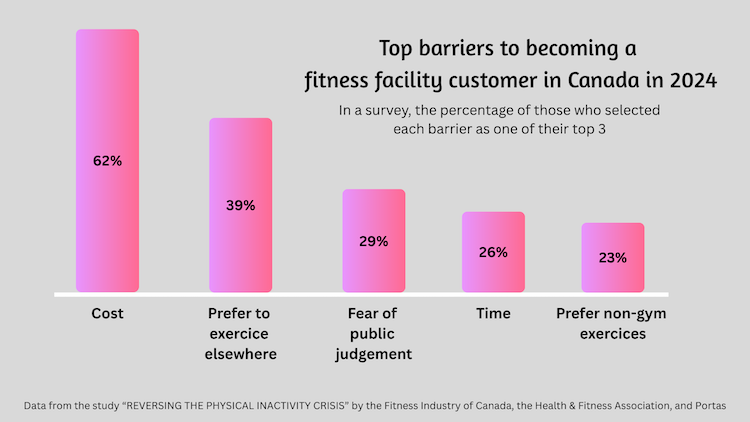
The results of a 2024 survey where Canadians selected their top three barriers for not becoming a fitness facility customer. Infographic by Demetra Kritsidimas.
According to research done on the topic, more than one in three Canadians say cost prevents them from establishing a healthy lifestyle. At the same time, 46 per cent say a fitness tax credit would motivate them to build a consistent routine, and 42 per cent say it would encourage them to purchase a membership.
These figures highlight a growing tension: while fitness is increasingly seen as essential, access is still uneven.
Phelan says that the shift from discretionary spending to necessity is already happening.
“One of the most important changes we’re seeing is that fitness is increasingly viewed as part of a health routine, not a luxury expense,” she says.
She adds that boutique studios are also increasingly functioning as “third spaces,” environments outside of home and work where people build routine, community, and a sense of belonging.
“Boutique’s real advantage is not the workout itself,” she says. “It’s the sense of belonging and identity it creates.”
More generation Z are skipping solo workouts in favour of group training. Here’s a quick look at what’s behind this shift. Video by Kassidy Jacobs.
For fitness amateurs like Nathalie Des Rosiers, that value can outweigh the higher cost.
“I find the prices are higher, but I actually go more and hit new personal records,” she says. “I’ve gotten much healthier and stronger compared to when I went to an open gym.”
After years of cycling, triathlons and traditional gym use, she says structured classes helped her stay consistent in a way that independent workouts didn’t. Now pregnant, she still goes twice a week.
“I wanted the accountability and access to a professional trainer to correct posture and techniques when working out,” Des Rosiers says.
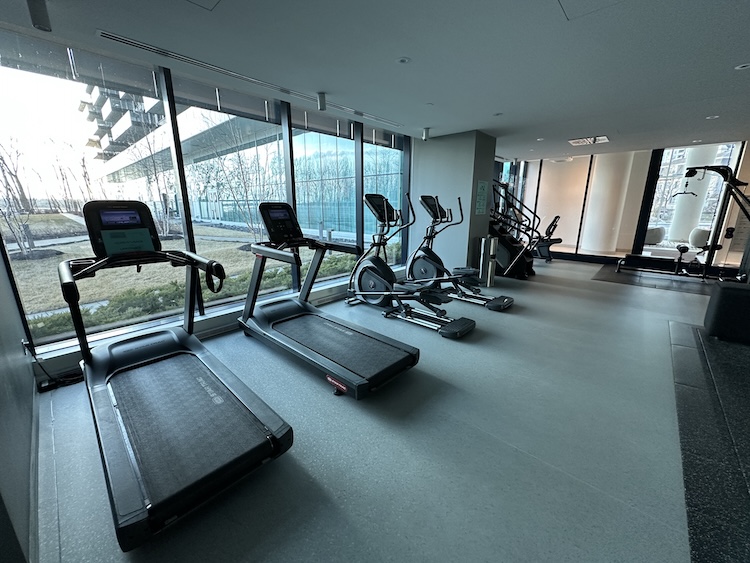
Treadmills and stationary bikes inside a traditional gym, which are available at a much lower cost than boutique fitness. Photo by Demetra Kritsidimas.
That access to guidance is another key difference. Instructors can adjust movements, prevent injury and tailor exercises in real time. Appel notes that many Pilates exercises mirror those used in rehabilitation settings.
“Every time you go to a physio or osteo [for injuries], they give you movements—and those are usually movements you find in Pilates,” Appel says.
Still, group fitness is not for everyone. Some people prefer the independence and flexibility of traditional gyms, or simply don’t want to commit to a set schedule.
“There are a lot of people who would not go to a group class,” Eys says. “They want to be in a gym by themselves and not be tied down to a group.”