
BY Max Moller & Dario De Felice
Jacob Bartnicky knows what’s good for him. He’s 28, and ever since he started working out during COVID, he’s been especially mindful of the food that he eats.
As he walks through a Super C, he can point at any food and explain how it does or doesn’t fit into his diet. His goal is to hit 200 grams of protein per day, or one gram per pound of body weight, and he is determined to fill that quota.
“I used to do some gross shit to get enough protein,” he recalls, “I would get cartons of egg whites and mix them with pre-made protein chocolate milk, and I would chug that.”
He arrives at a shelf displaying two rows of tortillas, more or less identical products. Same company, same size, same amount of tortillas. But Bartnicky knows which one he’s going to get. Only one of the packages will help him complete his mission.
“I’m so much more likely to get this one,” he says, pointing to the row on the left, and at a green label boasting 13 grams of protein per serving. “Something like that, I don’t feel nearly as guilty having.”

Jacob Bartnickey holds protein-enriched tortillas. POM launched a new line of protein-enriched products in January 2026. Photo by Max Moller.
Tortillas aren’t the only product using protein as a selling point. A long established staple of workout dieting, protein has increasingly crossed over into mainstream food culture.
Jo-Ann McArthur, president of food marketing firm Nourish Marketing, says that the protein craze has officially eclipsed fad, and now qualifies as a capital T trend.
“I think we’re reaching peak protein,” she says.
This shift is especially noticeable in grocery store aisles, where protein-enriched versions of everyday foods such as pasta, bread, and milk, are now readily available. Take a trip to your local Maxi or Metro and you can see dozens of new, protein enriched foods, each item proudly announcing “Buy me! I’m enriched! I’m the healthy option!”
“There is a huge fear of not getting enough protein,” says Ontario dietitian Jeffrey Lalonde, “and people are spending a lot of money for it,” he says. “It’s been monetized by food companies.”
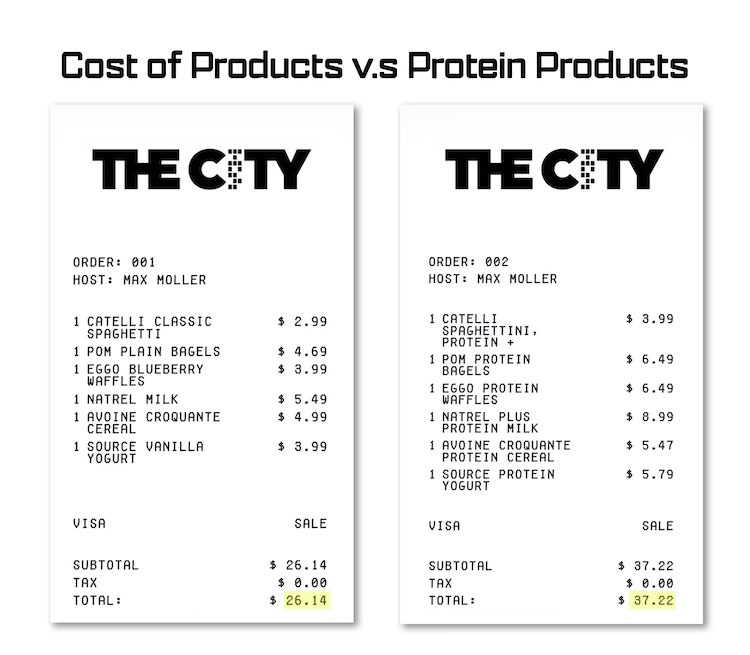
Price comparison between products and their protein-enriched counterparts. Prices taken from Super C, March 2026. Infographic by Max Moller.
How did we get here? Lalonde says he thinks it stems from a societal fear of carbohydrates.
“Unfortunately, they’ve been demonized […] people are afraid to eat too many of them, so they fill that place with protein,” he says.
He also points out that carbs are often associated with weight gain.
“Energy is energy, whether you get it from carbohydrates, protein, or fat,” he says. “Most Canadians already get enough protein. I think people have this idea that more is better, but once you’ve met your needs, more is not better.”
Lanalonde further explains that if you exceed the amount of protein that your body can process, it gets converted and stored as fat.
“You don’t just keep protein around, just waiting for when you need it to build muscle,” he says.
Ryan Schwartz has been the owner of a protein supplement company for five years, and before that he’d been engrained in work-out culture for another decade and a half. He believes that on average, people are getting half as much protein as they ought to be.

Ryan Schwartz displays one of his PWR4ALL protein bars. Photo by Max Moller.
Despite his long-standing commitment to protein, Schwartz is mostly dismissive of the protein craze.
“I find it interesting, but I also find it disingenuous now. There’s a lot of crappy marketing out there, they’re throwing the word protein on everything, and it doesn’t mean much,” he says. “If you take a bag of Ruffles and add four or five grams of protein, all of a sudden it’s a protein snack. But it’s not.”
Why does protein work as a selling point?
“Marketers, guilty as charged,” McArthur says. “Understand that adding protein to a Tim Hortons cappuccino gives it a health halo.”
McAurthur explains the health halo as an aura which negates the negative aspects of the food in question, leaving the buyer with the warm and fuzzy feeling that they made the healthy choice. “It just checks the box,” McArthur says.
Back at the Super C, Jacob examines a bag of Pure Protein popped crisps, hickory BBQ flavour. A side-by-side comparison between the protein crisps and a regular bag of lays reveals that the nutritional content (or lack thereof) is more or less the same between the two snacks.
They contain oughly the same amount of calories and fats, and the protein chips had more sodium per serving. This is the case with many protein-enhanced processed foods: despite their healthy aura, they are still processed.
The government recently stepped in to force manufacturers to include larger and better labels. But experts question how effective the labelling will be.
New nutrition warning labels are hitting grocery store shelves across Canada, but experts say while they’re a step forward, gaps in the system and consumer habits may limit their impact. Video by Dario De Felice.
Most medical professionals, Lalonde says, would recommend eating whole, minimally processed foods. “Supplements are processed. That’s what they are by nature,” he says.
Bartnicky prefers to get his protein from whole foods, so these kinds of processed protein snacks aren’t go-tos for him. Nevertheless, he sees the appeal, and says that the presence of protein would help negate the guilt of eating a processed snack.
“Saying it out loud, it’s funny,” he says, examining the nutrition labels on both bags of chips. “I guess it’s maybe not the best logic, but that’s how I think about it.”

Jacob Bartnicky examines the yogurt aisle. He says that this is one of his favourite sources of protein. Photo by Max Moller.
Schwartz says he’s also seen plenty of people exhibit this type of flawed logic where protein and healthiness exist in a one to one ratio. “It’s a quick fix,” he says. “Before protein, it was fat. Then, it was the sugar. There’s like a blame game.”
McArthur also says that the protein trend is simply the latest reincarnation of the nutritional blame game.
“If you go back, you can see it’s been repackaged over the decades in different ways. There was the Atkins diet, then that became the south beach diet, then it became the Keto diet, and now it’s protein maxing. It’s exactly the same thing.”
All of these trends, she says, have focused on a single nutrient as the locus of health, and tend to cast aside other aspects of food as irrelevant.

An advertisement for Catelli protein-enriched pasta at McGill metro station. Photo by Max Moller.
Schwartz blames social media. “It’s frustrating. People seem to take somebody’s amount of followers and popularity as credentials or an education.” He also says that he thinks people tend to take advice from people who look “healthy,” regardless of their actual expertise.
“They see a male model, jacked up on steroids, and think ‘this guy must know what he’s talking about!’ But what’s going on behind the scenes?” he says.
Lalonde agrees: “I think a lot of the advice people are getting now is to determine how they look immediately, as opposed to long-term health.”
“The key with one’s eating habits is variety,” Lalonde says, “because no food has exactly the same nutrients.” For example, beans and lentils are high in fiber, and low in cholesterol and saturated fat. Meat, on the other hand, has more fat, more vitamin B12, and more iron. Both are sources of protein, but they have a very different makeup of other nutrients, all of which are required by the body.
He adds that it’s important to acknowledge food as more than just fuel for the body. “There’s more to food than nutrients, right? It’s a part of our culture, we use food in celebrations,” he says.
Bartnicky says that these days, he doesn’t track his protein intake as strictly. He stays away from TikTok, and prefers to follow eating habits which allow him to naturally hit his quota without counting nutrients.
“If I’m getting my daily protein intake, I feel like I can allow myself to eat other things that aren’t necessarily healthy,” he says. “If I want to have a slice of pizza or a beer, I don’t feel bad doing it.”