
BY Jia Marguerite Schofer & Max Moller
Anita Martella is behind the front desk when the first call comes in. A customer is trying to reach their storage unit, but the street is blocked.
“They assume we’re open, but they can’t even access the street to come to the building,” she says.
Some days, the street works. Some days, it doesn’t. By late morning, Martella is forced to close the office. It’s not the first time.
“This just happens now,” she says. “That’s really annoying because do I shut down? Do I not?”
Martella is the only employee of BA Storage, located at the northern end of Ch. Bates, in Côte-des-Neiges–Notre-Dame-de-Grâce. It was once an exclusively industrial zone.
“This street used to be all industrial, and now everything is practically condemned,” Martella says.

Anita Martella at work at BA Storage in ôte-des-Neiges–Notre-Dame-de-Grâce. Photo by Jia Marguerite Schofer.
Ch. Bates runs through three municipal areas: Côte-des-Neiges–Notre-Dame-de-Grâce, the Town of Mount Royal (TMR), and Outremont, which are being reshaped by a single planning logic.
Once an industrial corridor hosting storage and light manufacturing, Bates is being rezoned, block by block, for high-density housing, creating a residential corridor of condominiums and bike lanes with growing green spaces.
Walking away from Martella’s storage unit, you can really notice that the further south you walk, the more glass balconies and for-rent signs appear.
Where these so-called ‘condemned’ buildings stand isolated, and the storage unit occupies a large parking lot. But just stroll away, the condominiums are tightly squeezed, with new ones emerging where space permits.

Ch. Bates under construction. Photo by Jia Marguerite Schofer.
“Worth it? I guess for aesthetics, because it’s going to look very nice, but we’re going to be one of the only businesses on the street now,” Martella says. “And who knows, maybe they’re going to want this for condos.”
The street doesn’t announce itself when you cross into the Town of Mount Royal. Isaac Hassan runs Shemoi Lighting on Ch. Bates, one of the few industrial businesses left in TMR’s stretch of the road.
“I’m not blaming anybody specifically,” Hassan says. “But definitely the city was lax in certain things because they wanted these [condominiums] going up very quickly to generate all these new revenues for tax purposes.”
The Town of Mount Royal published a notice C-2025-48 in Sep. 2025, detailing a multi-million-dollar redevelopment of Ch. Bates. The project is designed to reconstruct sidewalks, install drainag, and plant over 40 trees to replace the historical industrial aesthetic with a greener signature.
“This road, Ch. Bates, was one of the streets in TMR that was exclusively industrial for many years,” Hassan says.“It started changing into condos, and we are from there, and there are only a few businesses left on the street as most have changed to condos.”

Prospective 2520 Ch. Bates. Photo by Jia Marguerite Schofer.
The city is promising sustainability, walkability, and transit access. It also produces an indirect displacement harder to document.
Unlike displacements characterized by eviction notices and closing dates, the changes on Bates Rd. are less visible. Tax reassessments and blocked access are making operations more strenuous and more difficult for businesses to stay open. It’s almost impossible to imagine a future on a street that’s no longer designed for the people who still use it.
Carmela Cucuzzella, Dean of the Faculty of Environmental Design at the University of Montréal, says Ch. Bates fits into a larger planning logic.
“In this case, you can’t consider gentrification because the land use designation was previously for industrial activity.” she explains. “This designation was changed by the city so that the site is now zoned as residential, and is why new residences were built.”
A key accelerator of this transformation is the new station of the Réseau express métropolitain (REM), Montreal’s new rapid light-rail system, that was built across the street from the new residential area. The Canora station sits just east of the Town of Mount Royal boundary, outside this municipality’s limits. It serves as a primary node for a regional strategy to encourage residential growth near core transit nodes, according to Cucuzzella’s research.
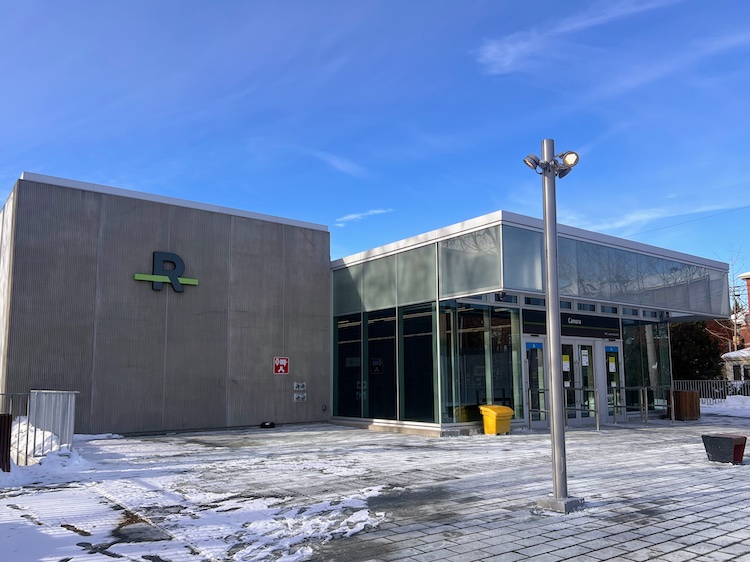
Canora REM Station. Photo by Jia Marguerite Schofer.
The shift did not begin with the REM, despite how it looks now, with trains gliding past every few minutes.
According to TMR Councillor, Sébastien Dreyfuss, the real catalyst came earlier, when the Canadian Pacific (CP) Rail sorting yard was dismantled to make room for UdeM’s Campus MIL. City planners saw an opportunity to increase TMR’s density without touching its single-family neighbourhoods.
“Because we have a housing crisis in general in Canada,” he says.
Bates Ch., already industrial and marginal, became the solution.
The Communauté métropolitaine de Montréal (CMM) oversees regional planning for the greater Montreal area. In 2012, they adopted the Plan métropolitain d’aménagement et de développement (PMAD).
According to this plan, 40 per cent of all household growth is to be concentrated along transportation networks. The goal is to increase walkability, boost transit ridership, and reduce greenhouse gas emissions by lowering reliance on cars.
“The original changes of that zoning were decided by the PMAD,” Dreyfuss explains. “To move that light industrial [zone] along the Bates track and to increase the densification.”
TMR, he says, would not destroy its residential fabric. So, density had to go somewhere else.
“It was more intelligent to do that where there was light industrial [zoning] which had very low value in terms of what they can bring, and they could be easily relocated.”
A map detailing the city zoning of the story site. Map by Jia Marguerite Schofer.
Low value here does not mean unused. It means underperforming, fiscally.
Alongside tax hikes, access has deteriorated with bike lanes replacing parking. Hassan submitted a letter to the TMR council about safety concerns, and he is still awaiting a response.
Dreyfuss defends the changes. The greenery, he says, is part of the town’s signature. It also serves a function, capturing rainwater to prevent flooding in TMR’s unitary sewer system.
Even the shrubs along the REM tracks have a purpose. They are visual barriers meant to reduce the psychological impact of seeing 500 daily train movements.
Walking farther south, past the REM tracks and into Outremont, the street tightens again.
At 183 Ch. Bates, band practice space known as The Crumper sits tucked between developments. It is trying to assure its future in the neighbourhood, but fears it won’t make it past the next five years.
The Crumper, a music practice space, is facing the threat of closure due to a rent increase. Video by Max Moller and Jia Marguerite Schofer.
Back north, Martella has lost count of how many people have tried to buy her out.
“Over the years, like, oh, my God, 20, 30 people coming in. Some man from Texas with a cowboy hat on. Left me his card and everything, and, yeah, but lots, lots, lots, lots, lots, lots.”
She pauses.
“No matter how many condos go up,” she says. “We’re not going anywhere.”