

BY Rojiar Ghezelbash & Marco Gavita
When Mathilde Choquette began experiencing unusual bleeding and stomach pain, the first doctor she visited suggested going to the emergency room or waiting until her condition worsened.
Choquette says she felt dismissed by the doctor who sent her home without any tests.
“The first doctor didn’t even make me do any bloodwork,” says Choquette.
After months of these symptoms and a visit to another doctor, Choquette was told she would have to wait up to six more months for further testing. By then, her symptoms had already taken a toll on her both physically and mentally.
Three months later, Choquette was finally diagnosed with Ulcerative Colitis (UC), a type of inflammatory Bowel Disease (IBD) that targets the intestines. This autoimmune disease causes chronic inflammation and ulcers in the lining of the colon and rectum.
“No one understands because it’s literally invisible,” says Choquette.

Choquette working on her laptop at a coffee shop while drinking matcha which she uses as an alternative to coffee to help manage her symptoms. Photo by Rojiar Ghezelbash.
Living with an autoimmune disease has forced Choquette to adjust her daily habits, from what she eats to how she spends her time. Simple routines, like when to have her coffee or when to leave the house, now require planning, as her energy levels aren’t always consistent, and her symptoms can flare up unpredictably.
“I just have to think everything through and calculate,” says Choquette. “I miss being free, having my coffee freely. Going to coffee shops used to be my favourite activity.”
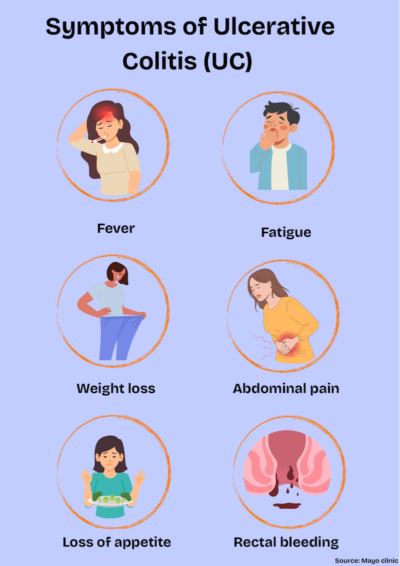
Illustration of common symptoms of ulcerative colitis. Photo by Rojiar Ghezelbash.
For people living with autoimmune diseases, conditions in which the body’s immune system attacks itself, the loss of control is part of everyday life.
For conditions like IBD, inflammation in the intestines is typically managed through medication, while lifestyle adjustments play a supporting role.
Nárlon C. Boa Sorte Silva, associate professor at Concordia University in the Department of Health, Kinesiology and Applied Physiology, says physical activity can help regulate inflammation and support overall health.
“For some autoimmune diseases, exercise has anti-inflammatory effects, and they tend to be one of the mechanisms of how exercise promotes health,” says Silva.
Inflammation tends to increase with age, and when combined with autoimmune diseases, it can lead to more severe health outcomes.
“With exercising, you can deal with pain in a much more manageable manner,” says Silva.
“Indirectly, [exercise is] a way to cope with the symptoms or prevent worsening of the disease,” he added.
However, for Choquette, worsening symptoms have made it difficult to maintain an active routine.
“I stopped the gym when I got the diagnosis. I couldn't eat my fuel,” says Choquette. “I used to be a full-on gym girl.”

Choquette sits alone on a bench outdoors with a cappuccino in hand. Photo by Rojiar Ghezelbash.
The experiences described by Choquette are not unique. Isabelle Filteau, founder of the Canadian Society of Autoimmune Diseases, is living with multiple autoimmune conditions that affect her day to day. Her most recent diagnosis is stiff person syndrome, a rare neurological disorder also affecting Canadian singer Céline Dion.
Filteau says her experience with autoimmune diseases exposed a lack of support and awareness in Canada.
“People don’t really know the term. It’s not something like cancer that everyone talks about,” says Filteau. “They would say, ‘Autoimmune,’ what does that even mean? Is it like a peanut allergy?”
The Canadian Society of Autoimmune Diseases aims to raise awareness and improve access to research funding for autoimmune conditions, which are often treated as separate diseases.
Prior to the founding of the organization in January of 2026, there was no national organization in Canada that brought together people with autoimmune diseases or supported both patients and researchers.
“Researchers faced a gap when trying to secure funding from foundations because there was no association focused on autoimmune diseases and immunology anywhere in Canada,” says Filteau.
Much of the existing funding is tied to specific conditions, making it harder to support research that applies across multiple autoimmune diseases.
Filteau created the organization in two days, following research into potential treatments and the need for greater support to advance the research.
An estimated 7 million Canadians are affected by more than 100 autoimmune diseases, with new conditions being discovered every year.
As diagnoses increase, more people are being affected by a wide range of autoimmune diseases, including type 1 diabetes, multiple sclerosis (MS), rheumatoid arthritis (RA) and Crohn’s disease.
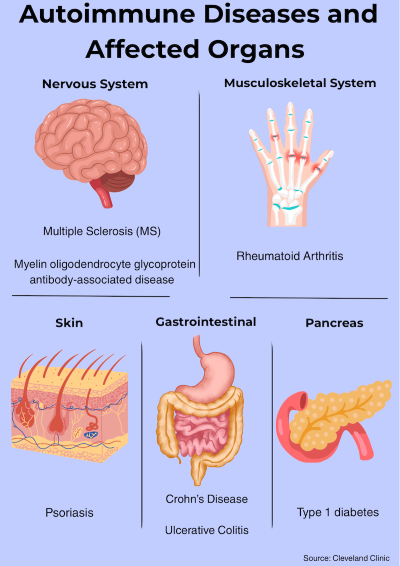
Visual representation of autoimmune diseases and the organs they target. Infographic by Rojiar Ghezelbash.
Research shows autoimmune diseases disproportionately affect women, who account for 75 per cent of cases. This difference is linked to hormonal and genetic factors.
In Canada, the number of people living with IBD is rising. About 322,600 people were affected in 2023, and that number is expected to reach 470,000 by 2035, according to Crohn’s and Colitis Canada.
Autoimmune diseases like UC often require strict diets to prevent flare-ups and manage symptoms. The condition limits social life, including going out with friends and drinking. Choquette found alcohol increasingly painful to consume as her disease makes the digestive system more sensitive and easily irritated.
Choquette is planning a trip to Australia, however, with a 16-hour flight, travelling has also become a source of anxiety.
“I’m scared of what I’m gonna eat on the plane,” says Choquette. “I have to eat as clean as possible, like the most useless foods I can find, rice crackers or boring stuff.”
Restaurants are adapting to chronic health dietary needs. Video by Marco Gavita.
Researchers are working to better understand and treat autoimmune diseases. Luc Vallières, neuroimmunologist at the Centre hospitalier universitaire (CHU) de Québec-Université Laval, is currently developing a new treatment for Myelin Oligodendrocyte Glycoprotein Antibody-associated Disease (MOGAD). MOGAD is a condition similar to multiple sclerosis (MS) that targets the brain and the spinal cord. Early results in mice have shown promise.
To study the disease, Vallières’ team of researchers developed a new animal model that includes the harmful antibodies responsible for the autoimmune condition, which the earlier models lacked. This model allows researchers to better understand how these antibodies attack the body.
“In an army, the soldiers are supposed to attack the enemy. For us, the enemy is bacteria, viruses,” says Vallières. “But in the case of an autoimmune disease, the soldiers react against themselves. So there is a rebellion.”
By focusing on harmful antibodies, his team found a way to block them using a modified, inactive antibody that attaches to the same target in the body without causing damage.
“We showed that if we take another antibody and we put it on the cells first, we prevent mice or human blood antibodies from binding. So it has a blocking effect,” says Vallières.
In simple terms, the treatment works by blocking the harmful antibodies before they can attack the body.
The treatment is at least five years away from reaching patients, as it must undergo further testing and FDA approval.
For now, the exact cause of autoimmune diseases remains unclear.
“In most cases, it’s a set of factors. So, probably small genetic differences that predispose to the disease, but also combined with environmental factors,” says Vallières. “But, it varies from one disease to another.”
While the treatment is still in early stages, it could lead to new therapies. Vallières says the same approach could eventually be adapted to other autoimmune diseases.
For Choquette, the impact of autoimmune diseases goes beyond physical symptoms. The mental toll is constant, especially as awareness remains low. As she orders a small cappuccino to go, she hopes for something simple: a better understanding.