
BY Emily Douris-Blondin & Lola Gomez-Ribeiro
Soccer has long been a constant for Jacqueline Daniel.
She began playing around age nine and continued through her teenage years, eventually moving from house league to a more competitive environment.
At first, the game felt simple, something she enjoyed and something she felt confident in. It gave her structure during the week and something to look forward to. But as the level increased, the experience began to change.
“It becomes more like you want the win more than you want to enjoy yourself,” she says.
By the time she reached her later teenage years, she decided to stop playing.
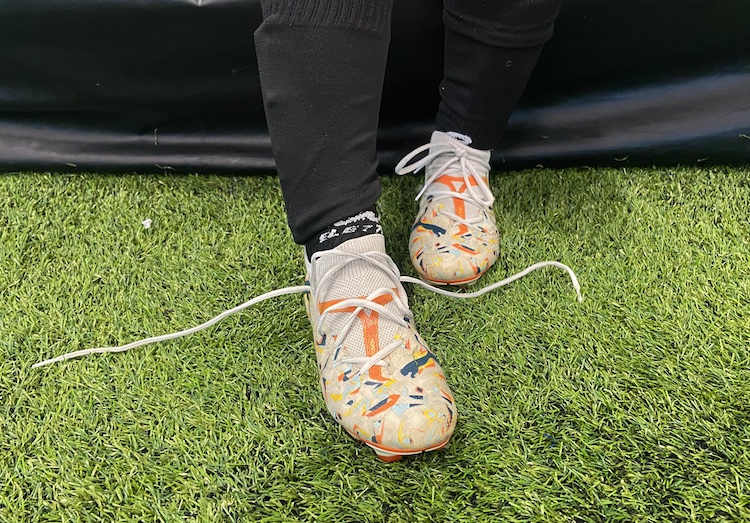
A young soccer player sits on the sideline, untied cleats resting on the turf. Photo by Emily Douris-Blondin.
In house league, coached by her father, the environment felt familiar and relaxed. Practices were consistent, expectations were low, and the focus was on participation rather than performance.
In competitive soccer, it felt different. The expectations were higher. The players already knew each other. The social dynamic was harder to navigate.
“I feel like I’m too good for house league, but not quite good enough for competitive,” she says.
That feeling stayed with her throughout the season. While she continued to show up to practices and games, the experience no longer felt the same. The pressure increased, and her confidence began to shift.
“Everyone already had their own groups,” she says. “I wasn’t really part of that.”
Meilina Lynch, assistant coach of the under-15 LDP LaSalle Rapides women’s team in Montreal, regularly sees uncomfortable transitions.
“There’s definitely been a big decrease,” Lynch says, referring to the number of girls who continue playing as they get older.
She observes that some players begin to drop out as the sport becomes more competitive, often in early adolescence, while others leave later when the commitment becomes difficult to balance with school or other priorities.
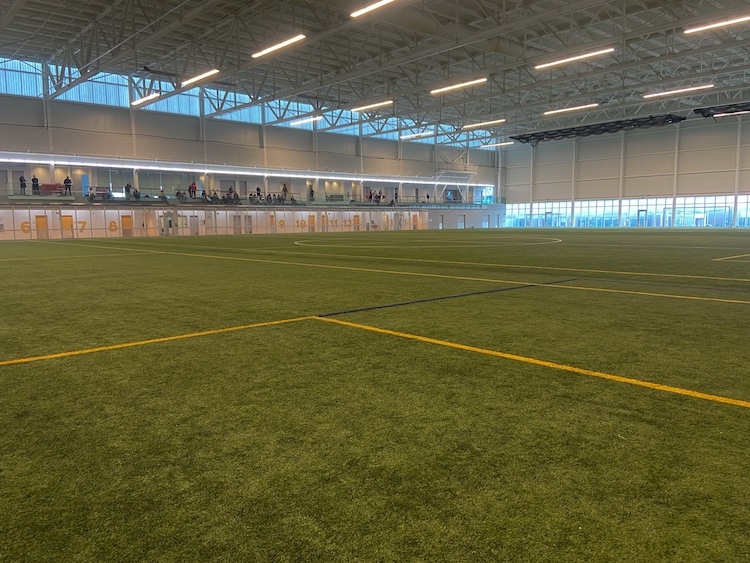
An indoor soccer field sits empty between games. A growing number of girls are stepping away from organized sport during their teenage years. Photo by Emily Douris-Blondin.
“It’s definitely about this confidence of wanting to keep going and knowing that you’re good enough,” she says. “It’s a mental battle.”
That struggle can become visible in small but telling moments. Lynch recalls a recent conversation with one of her players.
“She tells me this will probably be her last season,” Lynch says. “If you’re not ‘good enough’ to keep going, they don’t see it being worth it.”
As a coach, Lynch speaks from experience rather than research. What she sees is a shift, one where pressure arrives earlier and expectations grow faster.
“Starting as young as U4, parents take it much more seriously than it really needs to be,” she says.
She also notes that team environment plays a significant role in whether players stay involved. Friendships and a sense of belonging can influence motivation as much as performance.
“If they have a positive environment and their friends are there, they’re more likely to keep going,” she says.
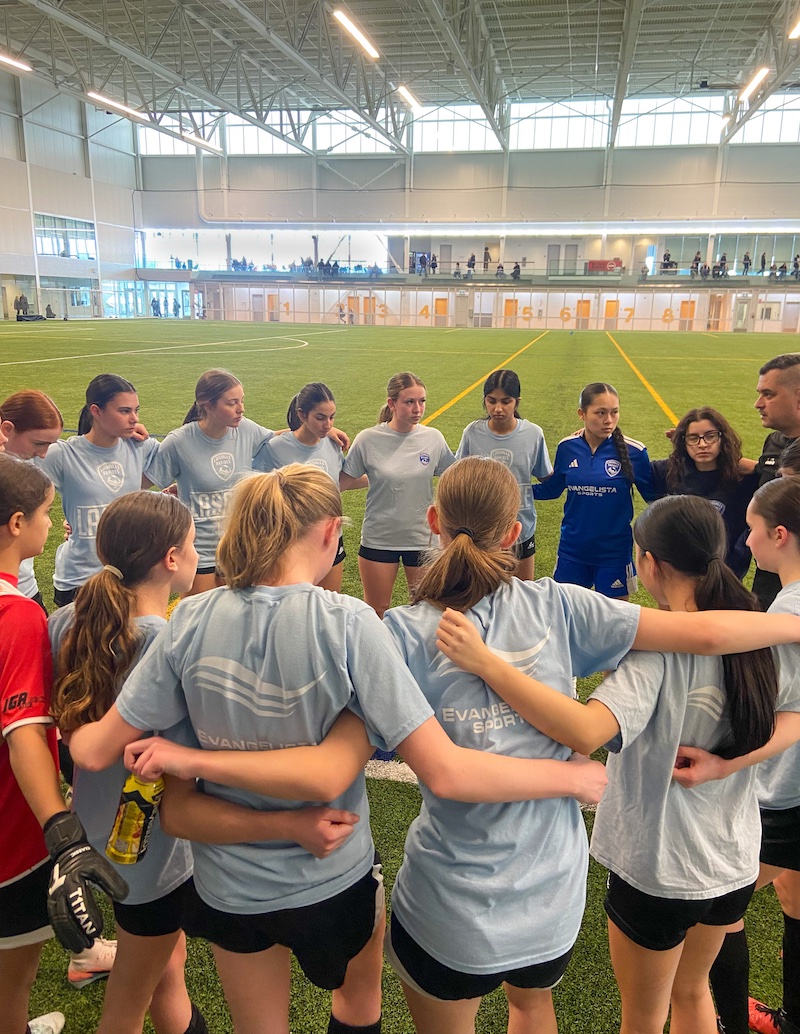
A girls’ soccer team gathers in a pre-game huddle, where strong team bonds and a sense of belonging can influence whether players stay in sport. Photo by Emily Douris-Blondin.
Erin Hall, a Montreal-based clinical psychologist who works with athletes, says sport often becomes deeply connected to identity, especially for those competing at higher levels.
“It’s very tied,” Hall says. “The higher the level, the stronger their athletic identity.”
When that identity is disrupted through injury, pressure, or stepping away from the sport, the emotional impact can be significant.
“That’s when we see a lot of anxiety, distress, and questions like, ‘Who am I without my sport?’” she says. “It hurts their self-worth and their confidence.”
In her work, Hall often sees athletes dealing with the psychological effects of being sidelined, whether temporarily or permanently. For some, injuries create uncertainty about returning to play. For others, stepping away from sport leads to a broader sense of loss.
“There can be grief,” Hall says. “A loss of identity and a loss of community.”
She explains that athletes who strongly identify with their sport may find it difficult to separate their performance from their sense of self. When participation changes, so does how they see themselves.
Cheryl MacDonald, CEO of Sport New-Nouveau Brunswick, says girls’ participation has historically been shaped by systems that were not designed with them in mind.
Despite teenage girls leaving sports at a time that matters most, Dr. Alex Ketchum and journalist Julian McKenzie expand on the rising trend of media attention to female sports. Video by Lola Gomez-Ribeiro.
“Sports weren’t built for girls to begin with,” she says.
Even as access improves, she says gaps remain in opportunity, visibility, and long-term pathways.
“You can’t be what you can’t see,” she says.
According to the 2024 Rally Report by Canadian Women & Sport, more than one in five girls drop out of sport during adolescence, and participation declines sharply by age 16.
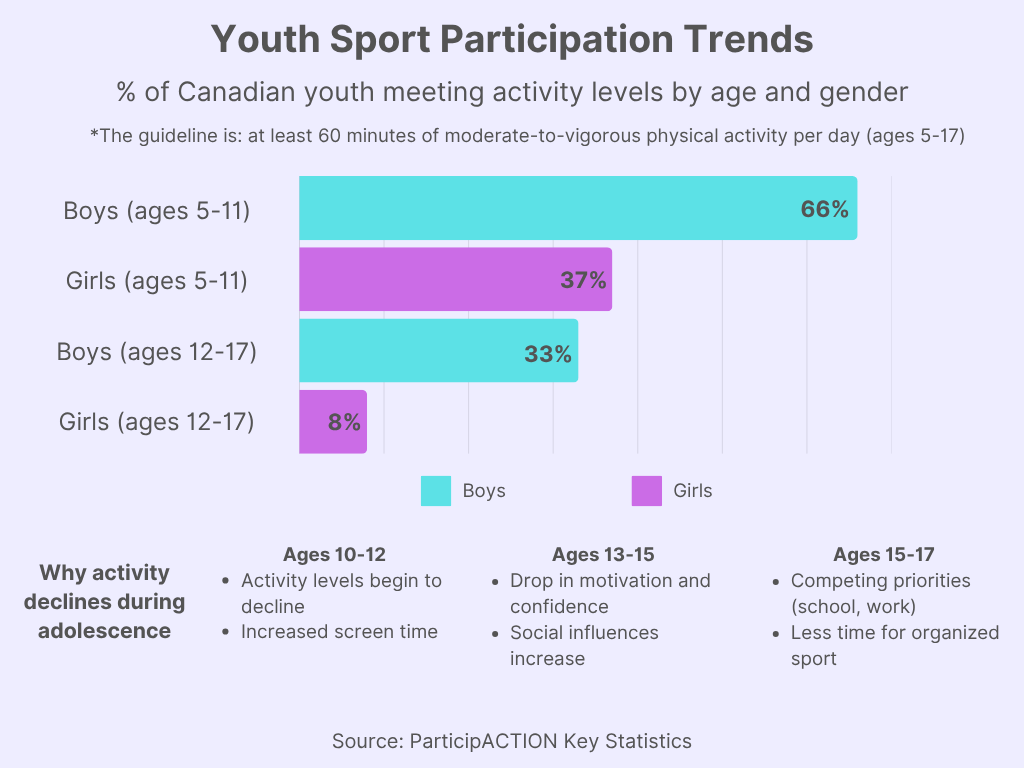
Data from ParticipACTION shows that physical activity levels drop significantly during adolescence, with far fewer girls meeting the recommended daily guidelines compared to boys. Photo by Emily Douris-Blondin.
“I think that’s where opportunities start to drop off,” MacDonald says. “And where expectations start to change.”
At the same time, sports environments become more structured and performance-driven.
“It becomes more of a job and an obligation,” she says.
She adds that early specialization and increased demands can shift sport away from enjoyment and toward performance, particularly during adolescence when expectations begin to rise.
Caroline Hummell, a sport psychology researcher at Brock University, says the reasons girls leave sport fall into both social and structural factors.
On the social side, girls report low confidence, lack of belonging, and limited access to role models. Structurally, sport environments often prioritize performance over well-being.
“Sport is still very much a win-at-all-costs culture,” Hummell says.
As athletes move into more competitive environments, the number of available opportunities decreases. Not all athletes continue to play at higher levels, and for some, that shift can influence how they view their place in sport.
One of the most important factors in keeping girls involved is enjoyment.
“The fun aspect is one of the most-cited reasons girls stay in sport,” Hummell says.
She adds that enjoyment and performance do not have to be separate. Creating environments that balance both can influence long-term participation.
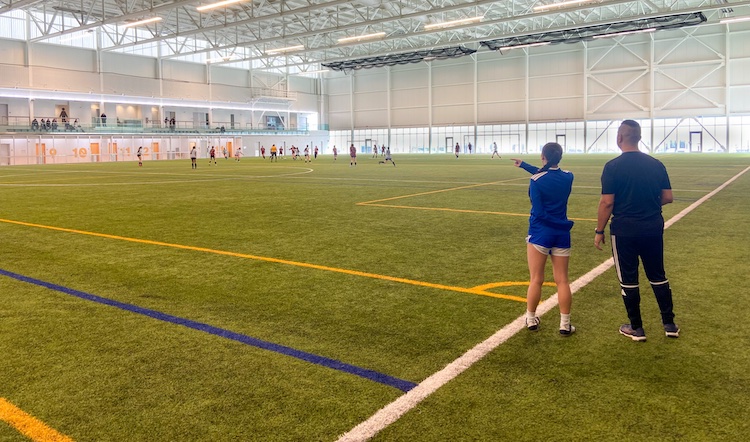
Two coaches give instructions to their team from the sideline during a youth soccer game, where team environment and support can play a key role in whether girls stay in sport. Photo by Emily Douris-Blondin.
“When you feel like you don’t belong, your confidence drops,” she says. “But having someone believe in you can make all the difference.”
For Daniel, that sense of support was missing.
Looking back, she says she wishes someone had encouraged her to stay.
“I wish I had more of a push,” she says. “It just felt too easy to drop it.”
Even now, she reflects on what the sport gave her: structure, confidence and a sense of purpose.
“I definitely do miss it,” she says.
While she does not see herself returning to competitive soccer, she remains open to playing again in a more relaxed setting.
“I would sign up for a house league,” she says.