

BY Luca Armano & Mathilde Colls
The ball clips the tape but still clears, forcing his opponent to stretch forward in a last-ditch effort to keep the point alive. Although the return comes through, it’s too soft and rises too high, giving Lucas Lewis a clear opening.
He seizes the moment, smashing the ball past his opponent and off the table to clinch the match. With that decisive shot, Lewis secures victory.
“For me, the thing that I like about ping-pong is that I like games like that that are very tactical and have a lot of hand-eye coordination,” says Lewis.

Lucas Lewis serves a ping-pong ball in Montreal Quebec. Photo by Luca Armano.
In Canada, around half of all adults are meeting the recommended amount of time doing physical activity. Many get their exercise by participating in a hobby. In Montreal, ping-pong is growing in popularity.
Lewis played ping-pong in middle school and recalls just how much he enjoyed it. He remembers playing with his friends and family, always having fun. Lewis is a full-time student at Concordia University. When he is not busy with classwork, he enjoys some friendly competition.
He says that pool and foosball have been his main hobbies until late last year, when he was walking in a mall near his apartment and saw a ping-pong club, PING MO. He was new in the area and excited to see a place where he could enjoy ping-pong again.
“It’s like, in a basement in a mall, and it’s got four really nice ping-pong tables,” says Lewis, as he describes the club. “I went with my friend and my girlfriend, and we had a great time.”
Opened in August 2025, the club is the newest ping-pong venue in Montreal. The facility is modern and operates without on-site staff. Players gain entry through a mobile app that unlocks the doors. Inside, tables are stocked with paddles and balls, and a pair of couches offers space to sit between games.

A picture of a ping-pong paddle offered by PING MO. Photo by Luca Armano.
The owner of the club, Selim Dris, opened it with his uncle. He says that he has always enjoyed playing ping-pong but never trained to play competitively. He says that many of the clubs in Montreal were too far for him to go regularly. His solution? To open his own ping-pong club closer to where he lived.
“I’ve always loved playing ping pong, I just missed a place to play for fun,” says Dris.
Dris says most clubs in Montreal, as well as being far from him, are also very competitive. It can be a tough barrier to entry for beginner players or people who just want to play for fun.
“Like, only good players play ping-pong, or the ones that train and try hard and improve,” says Dris.
He wanted to open a club in the downtown area where people could play recreationally, instead of focusing on coaching and training. The club offers various group activities geared towards creating a friendly, fun environment where everyone can participate. For example, they host King of the Table, during which various players rotate in and out of matches depending on who wins. Matches are played to 5 points instead of eleven or twenty-one. This makes for shorter games, so many people can participate without waiting too long on the sidelines. The winner gets to stay, and the person who loses switches with the next in line. Having shorter matches makes the game less competitive.
“The goal is to bring ping-pong closer to people of all levels,” says Dris.
For those who want to take it seriously, there is still the option to practice with a coach or with a robotic ball launcher. Since the club opened, the number of reservations and participation has increased, says Dris.
Lewis says he has been playing regularly since last September and has also noticed an increase in attendance at PING MO. He says that he used to be the only one playing. Now, when he walks through the doors, he is often met with a familiar sight: almost every table in use.
“Sometimes people come in and train on the robot machine for two hours,” Lewis says.
When he arrives with his girlfriend, Jane Illman, their visits rarely feel brief. They can spend up to three hours at a table, moving from one game to the next, each played to 21, keeping score with quiet intensity. Illman is hardly a novice herself.
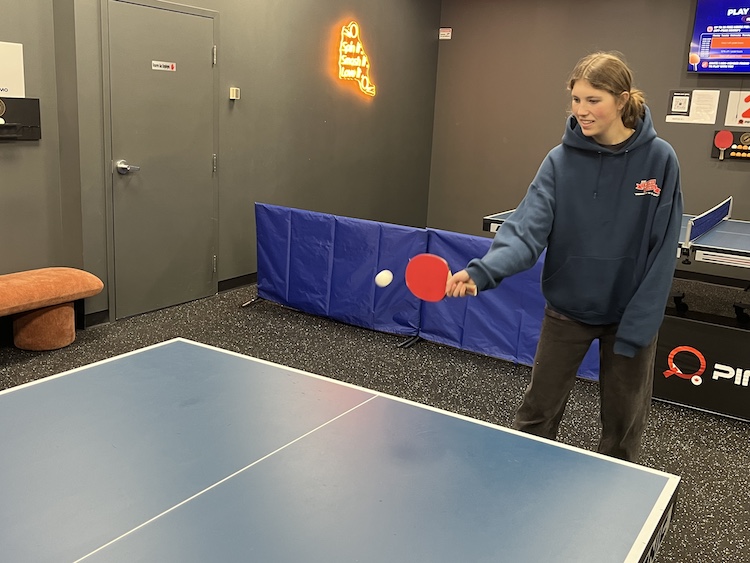
Jane Illman prepares to return the ball in a heated rally against Lewis in Montreal, Quebec. Photo by Luca Armano.
“I started probably when I was four in the basement of my dad’s house,” says Illman. “He was a painter, so he would use a paint bucket full of balls.”
Illman and Lewis have made it a point to integrate ping-pong into their weekly routine. They enjoy the friendly matches, even though Illman wins most of the time.
“I like the competition, it makes things exciting,” says Illman.
Both Illman and Lewis have been consistently improving. They say improving encourages them to keep going back to the club to play more.
“I just think it’s a fun game because it’s very frustrating,” says Lewis, “And you can see your improvement very quickly.”
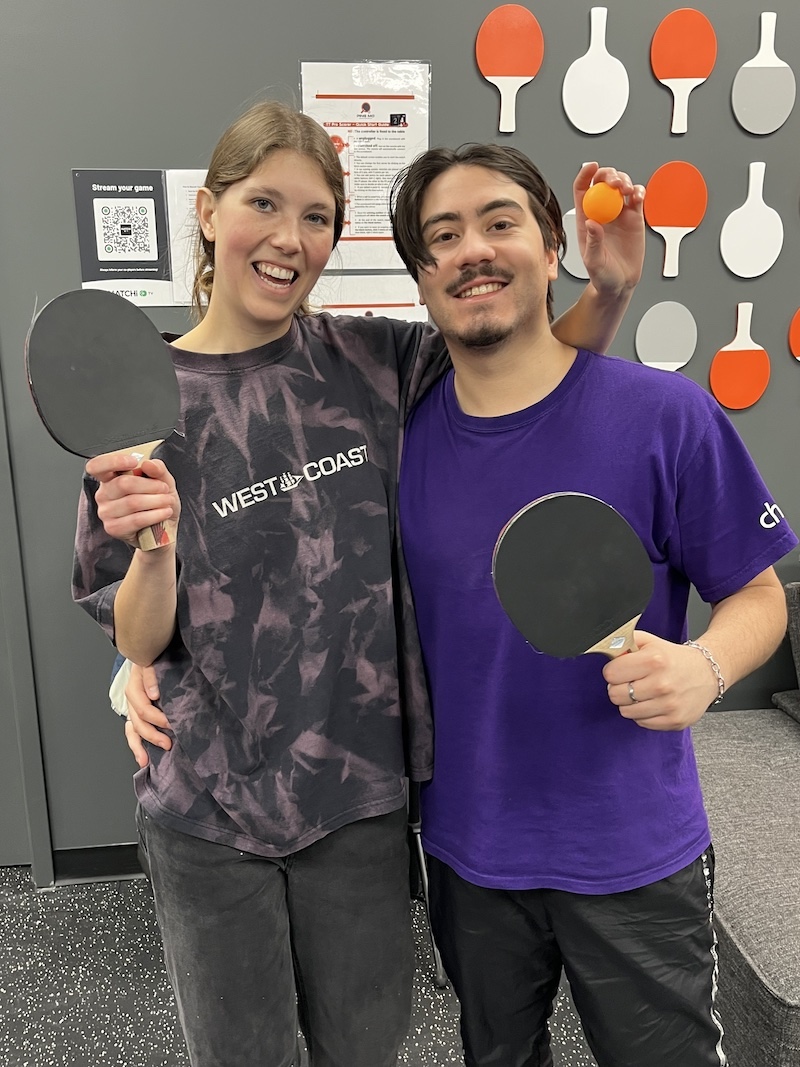
Lucas Lewis and Jane Illman pose after playing ping-pong in Montreal, Quebec. Photo by Luca Armano.
Its legitimacy on the world stage was cemented in 1988, when it made its Olympic debut at the Seoul Games, elevating a basement pastime into an event contested by the world’s elite athletes.
Churui Jiang started playing ping-pong in China. He eventually attended McGill University in Montreal, where he was the varsity ping-pong team captain. He has traveled all over Canada competing in tournaments in different clubs.
“Actually, Montreal and everywhere in Canada, we have a good community, like a big group of players,” says Jiang.
Jiang now coaches ping-pong either in groups or privately. He says that he has seen more people going to ping-pong clubs.
“Young kids get trained in many clubs, and there’s a trend,” says Jiang. “They started very young, and they try to get competitive.”
Jiang thinks that the growing popularity is a good thing for the overall ping-pong community. According to Table Tennis Canada, participation in tournaments reached record numbers in 2025.
The sport demands quick reflexes, balance, and sustained focus, providing a surprisingly rigorous workout disguised as play. People spend years training to perfect their technique and win competitions.
“I think it’s definitely good for your brain and body,” Lewis says.
Gaby Szabo, a health promotion specialist at Concordia University, says research consistently shows regular movement is essential to overall health. According to her, adults are encouraged to get at least 2.5 hours of moderate-to-vigorous physical activity each week. Between 2014 and 2015, about 17 per cent of adult Canadians met that target. The figure has since risen significantly, reaching 46 per cent between 2022 and 2024.

A look at the percentage of people meeting physical activity requirements in Canada. Graph by Luca Armano.
Many adults are busy with work, school, or family. As such, Szabo believes that it is a great idea to integrate exercise into leisure time or transportation time. She notes that not everyone enjoys structured workouts, so finding an activity that is both engaging and enjoyable can increase the likelihood of sticking with it.
“Time is limited, so doing two-in-one, whether commuting and exercising or socializing and exercising, is helpful,” Szabo says.
In Montreal, community leisure programs are using local outdoor activities such as cross-country skiing to help newcomers meet people and feel more at home. Mathilde Colls.
It is easy not to want to leave the house, she says. Hobbies and activities we enjoy help us get out more, be healthy, spend time with people we like, or meet new people.
Szabo stressed that regular physical activity lowers the risk of chronic illnesses such as heart disease and diabetes. She added that it can also improve mood, build resilience, and help buffer the effects of stress.
“Making an activity fun increases the likelihood that we’ll stick to it,” Szabo says. “The best active hobby is the one that you will do regularly, a few times a week.”